
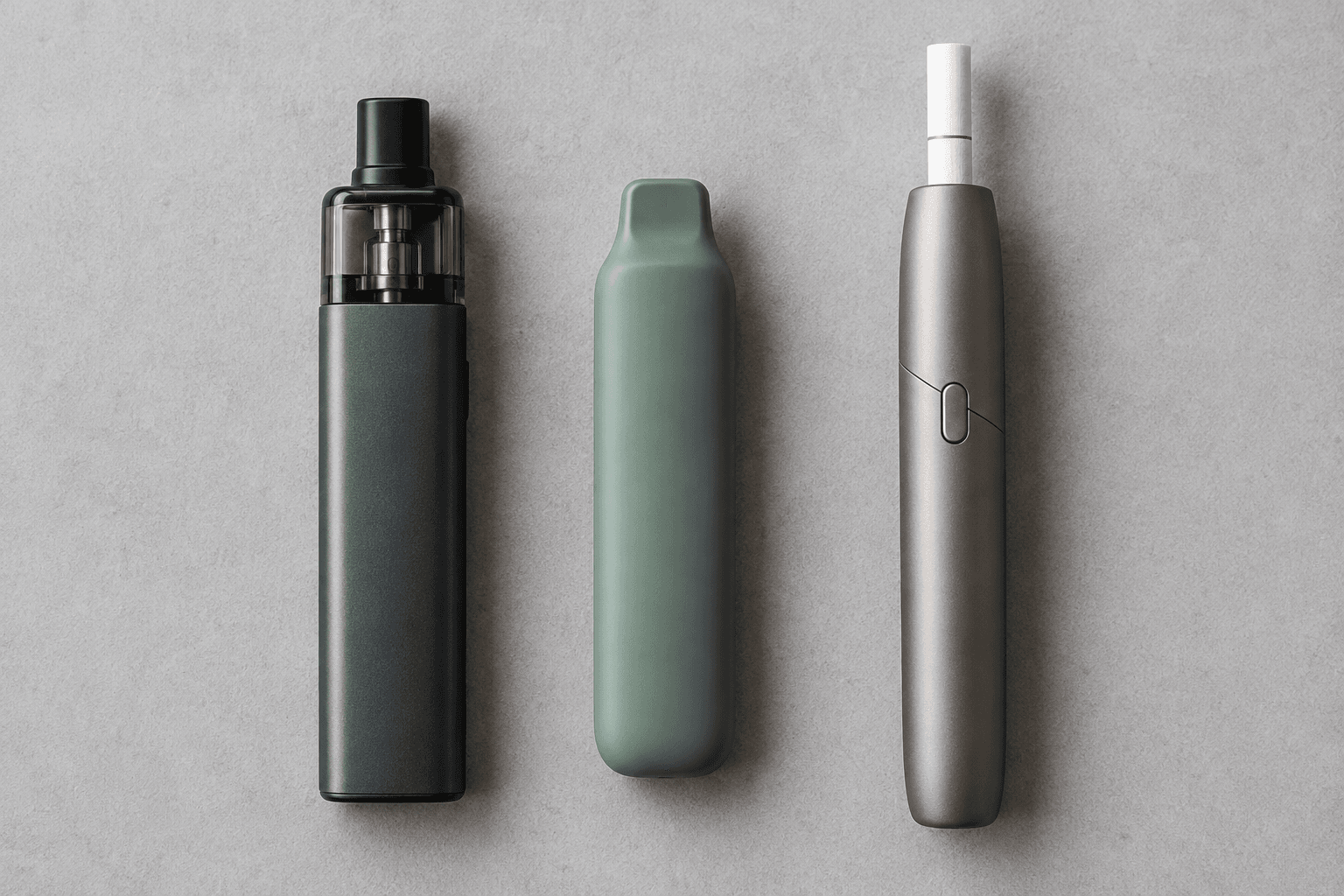
Producing, selling, importing, exporting, transporting, distributing, storing and advertising e-cigarettes is prohibited in India. Using one is not among the acts the Act lists. Those two sentences are both true, which is why this question produces so much confusion.
The law is the Prohibition of Electronic Cigarettes (Production, Manufacture, Import, Export, Transport, Sale, Distribution, Storage and Advertisement) Act, 2019, Act No. 42 of 2019. It received presidential assent on 5 December 2019 and is deemed to have come into force on 18 September 2019. The prohibited acts are listed in the title itself, which is unusually helpful.
Everything below is drawn from the text of the Act. It is a description of what the statute says, not legal advice, and not an opinion about what you can safely do.
What counts as an e-cigarette
Section 3(d) defines it as an electronic device that heats a substance, with or without nicotine and flavours, to create an aerosol for inhalation. The definition expressly includes all forms of Electronic Nicotine Delivery Systems, Heat Not Burn Products and e-Hookah, and "the like devices, by whatever name called and whatever shape, size or form it may have".
Two consequences follow. Heated tobacco devices are inside the definition, which is why the IQOS question is a question about a product covered by this Act. And "with or without nicotine" means a zero-nicotine device is still covered. Whether any of this makes vaping safer than smoking is a different question, and the Act does not address it.
There is one carve-out: anything licensed under the Drugs and Cosmetics Act, 1940, is outside the definition. That is the provision under which medicinal nicotine products sit.
That carve-out is worth understanding, because it is the reason two products that both deliver nicotine by inhalation can sit in completely different legal categories. What decides it is not the nicotine. It is whether the product has been licensed as a medicine. A device sold as a consumer product falls inside the definition, and a product licensed under the 1940 Act falls outside it.
Traditional coal-and-water hookah is not an electronic device and is not covered.
What section 4 prohibits
Section 4 says that no person shall, directly or indirectly, produce or manufacture or import or export or transport or sell or distribute electronic cigarettes, "whether as a complete product or any part thereof". It also prohibits advertising them, or taking part in any advertisement that directly or indirectly promotes their use.
Two words in that sentence do a lot of work.
There is also a structural point about how section 4 is written. It is a list, not a general prohibition. The Act does not say that electronic cigarettes are unlawful; it says that a set of named activities involving them are. That is why the answer to this question keeps splitting in two, and why reading the list matters more than reading the headline. The definition in section 3(d), by contrast, is written to be deliberately wide, in the terms quoted above, so a novel form of device is unlikely to fall outside it.
"Person" includes an individual. Section 3(i) defines it to cover any individual or group of individuals, alongside firms, companies and the rest. These prohibitions are not limited to businesses.
"Transport" is on the list. Use, consumption and possession are not. The words do not appear among the prohibited acts anywhere in the Act, and the only place possession is mentioned at all is in section 5's provision about an owner listing existing stock.
That is the honest shape of it, and it is why queries like "is keeping a vape illegal in India" and "is carrying a vape illegal in India" have no comfortable answer. The Act does not list keeping or using. It does list transporting, and it binds individuals. Whether a given act of carrying falls inside "transport" is a question of interpretation that courts and authorities decide, not one an article can resolve for you.
Storage, searches and penalties
Section 5 prohibits an owner or occupier, or anyone with control or use of a place, from knowingly permitting it to be used for storage of any stock of e-cigarettes.
Section 6 allows an authorised officer who has reason to believe the Act is being contravened to enter and search without a warrant, and to seize records or property, subject to the Code of Criminal Procedure, 1973. An authorised officer means a police officer not below the rank of sub-inspector, or another officer of at least that rank authorised by notification.
The penalties are set out in two sections. Contravening section 4 is punishable with imprisonment up to one year, or a fine up to one lakh rupees, or both. For a second or subsequent offence it rises to imprisonment up to three years and a fine up to five lakh rupees. Contravening section 5, the storage provision, carries imprisonment up to six months, or a fine up to fifty thousand rupees, or both.
Two procedural points are worth knowing because they rarely get mentioned. Under section 12, no court can take cognizance of an offence under the Act except on a written complaint by an authorised officer. Under section 13, only a section 4 offence is cognizable.
What this article is not doing
It is not telling you whether you personally are at risk, because that depends on facts an article does not have. It is not advice on carrying a device through an airport, and we are not going to write that. And it is not a route around the Act. If your situation is specific, the person to ask is a lawyer in India, not a blog.
We have also kept our opinion of the policy out of this. It is the law as it stands, and our readers are the ones living with it.
Our own position here is narrow, and worth stating as ours. We write about vapes because people arrive using them, and someone trying to stop is in a different situation from someone being sold something. We are not going to tell you the ban is good or bad, and we are not going to help you work around it. Both of those sit outside what a company in our position should be doing.
Where Nicoxit comes in
Nicoxit is a seven-day course, 31 modules, built on published behavioural science. It covers cigarettes, vapes, hookah and IQOS, because people arrive using all four, and helping someone stop using something is a different activity from any of the acts section 4 lists.
If you are trying to stop, the vaping-specific guide is here.
Not legal advice. Not medical advice.
References
- Ministry of Law and Justice, Government of India. (2019). The Prohibition of Electronic Cigarettes (Production, Manufacture, Import, Export, Transport, Sale, Distribution, Storage and Advertisement) Act, 2019 (Act No. 42 of 2019). The Gazette of India, Extraordinary, Part II, Section 1. https://violation-reporting.ntcp.mohfw.gov.in/assets/images/PECA_2019.pdf
Frequently asked questions
Is vaping illegal in India?
Producing, manufacturing, importing, exporting, transporting, selling, distributing, storing and advertising e-cigarettes is prohibited under Act No. 42 of 2019. Use, consumption and possession are not among the acts the Act lists.
Is it illegal to own or carry a vape in India?
The Act does not list owning or using. It does list transport, and section 3(i) defines "person" to include an individual. Whether a particular act of carrying falls inside "transport" is a matter of interpretation for authorities and courts, so a lawyer is the right person to ask about a specific situation.
What is the penalty for selling e-cigarettes in India?
Imprisonment up to one year, or a fine up to one lakh rupees, or both, for a first offence under section 4. For a second or subsequent offence, imprisonment up to three years and a fine up to five lakh rupees.
Does the ban cover nicotine-free vapes and IQOS?
Yes on both counts as the definition is written. Section 3(d) covers devices "with or without nicotine and flavours", and expressly names Heat Not Burn Products and e-Hookah.
Is hookah banned under this Act?
Traditional hookah is not an electronic device, so it falls outside this definition. E-Hookah is expressly named inside it.