
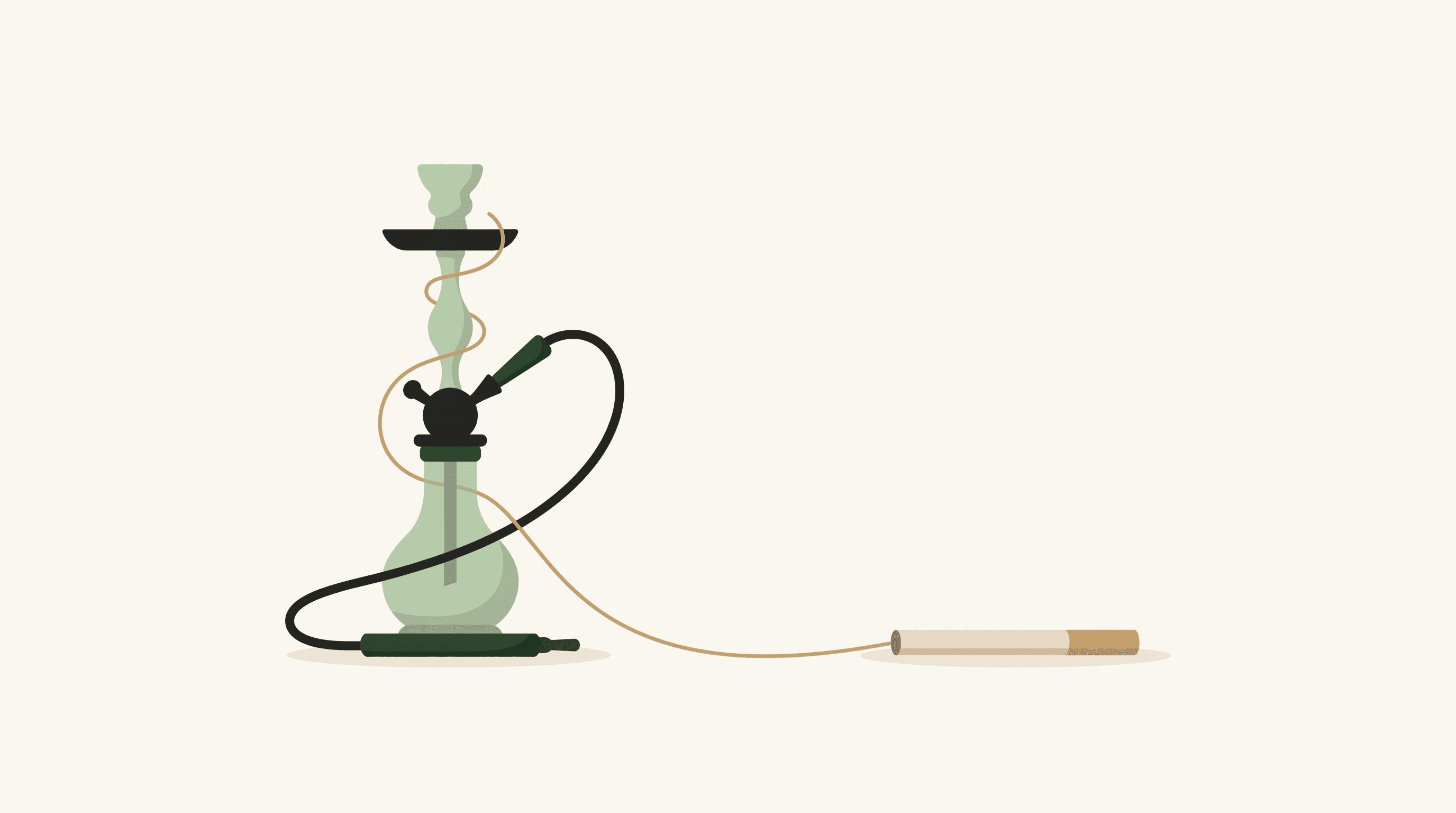
You don't smoke. You just do hookah sometimes — a Friday on the rooftop, the round going around, the long sit that finally slows the week down. It's flavoured, it goes through water, and it's only the weekend. Three quiet reasons it doesn't count.
Those three reasons are worth looking at directly, because each one is doing more work than you think — the first two are about the smoke, and the third is about something harder to see.
"The water filters it"
This is the belief the whole ritual rests on, and it's the one the science is clearest about.
What the water takes away is the cough and the burn — the signal that would otherwise tell you to stop. It makes the smoke easier to take in. It doesn't make it cleaner. What the water does not do is filter out the toxins. According to the World Health Organization, the smoke that reaches your lungs after passing through the water still carries carbon monoxide, heavy metals, and cancer-causing chemicals.
Smoother is not the same as safer. The water removes the signal — the cough, the burn — that would otherwise tell you to stop.
The part the smoothness hides
Because it's easy to inhale, a hookah session isn't a cigarette-sized dose. A typical hour-long session involves inhaling roughly 100 times the volume of smoke of a single cigarette. The charcoal that keeps the bowl lit adds its own carbon monoxide on top of the tobacco's — and that exposure builds across a long sitting — which is part of why a session can leave you light-headed.
None of this is meant to frighten you, and a weekend hookah is not a medical emergency. It's just worth saying plainly, once, because the entire appeal of hookah is built on the feeling that it's the gentle option — and that feeling is manufactured by the water, not supported by the smoke.
The reason none of that will make you stop
Here's the honest part. You could read every statistic above, nod, and still be on the rooftop next Friday. Facts rarely end a habit, because the habit was never only about the tobacco. It was about the belief.
And hookah's belief is a particularly good hiding place: "it's only weekends."
That phrase is perfectly designed to keep the loop alive. It's never quite enough to alarm you, and always quite enough to keep the door open. It's the same move as the smoker who only has "one after lunch," or the vaper who insists it's not really smoking. The form changes — cigarette to vape to IQOS to "only hookah, only weekends" — but as we covered in why quitting is a belief problem, not a willpower problem, the form is just the delivery. The belief is the dependency, and it doesn't care which bowl it's in.
What your brain actually learned on that rooftop
Your brain never tracked what was in the bowl. It tracked the moment — the long sit, the round going around, the break from everything, the people you only really relax around. What it learned was: this is how a week gets survived.
That's why hookah is stickier than its "only weekends" cover suggests. What you'd miss if you stopped is probably less the tobacco than the rest of it — the ritual, the company, the two hours that belong to no one else. That need is completely real, and it's one of the borrowed beliefs worth naming clearly: the smoke has quietly attached itself to something good — friendship, rest, escape — that it isn't actually providing.
How to loosen it
You don't have to quit the rooftop, the circle, or the sit-down. You have to separate them from the bowl — and the way to start is to catch the belief in the act.
Before the next session, name what you expect it to do: "this is how I relax with them," "this is my break." Afterwards, ask one honest question — did the relaxing come from the tobacco, or from the two hours with people you like and a phone you finally put down? Do that a few times and the belief starts to come apart on its own, because you can see, in your own experience, that the good part was never the smoke.
The position this post defends
Hookah gets a pass that cigarettes don't, and the pass is built on a feeling of gentleness that the water manufactures and the science doesn't back. But the health facts alone were never going to be the thing that frees you. The belief matters too — "it's only weekends," quietly holding the door open. Once you see that the belonging is real and the bowl is optional, the weekend stops needing it.
The bowl kept changing. The belief never did.
Curious which belief has the strongest hold on you? Take the 3-minute Quit Profile quiz, and your personalised plan lands in your inbox the morning we launch.
Related reading:
- Why You Can't Quit Smoking (It's Not Willpower)
- 9 Borrowed Beliefs Every Smoker Carries
- Quit Vaping in 7 Days — A Guide for Young Adults
- Our Method: How the 7-Day Course Works
References
- World Health Organization (EMRO). The truth about waterpipe tobacco use. https://www.emro.who.int/tfi/know-the-truth/waterpipe-tobacco-use.html
- Centers for Disease Control and Prevention. Hookahs. https://www.cdc.gov/tobacco/other-tobacco-products/hookahs.html
- Sepidarkish, M., et al. (2025). The waterpipe smoking and human health: a systematic review and meta-analysis of 191 observational studies. Systematic Reviews, 14:74. https://doi.org/10.1186/s13643-025-02799-y
- Hammal, F., et al. (2015). 'Herbal' but potentially hazardous: an analysis of the constituents and smoke emissions of tobacco-free waterpipe products and the air quality in the cafés where they are served. Tobacco Control, 24(3), 290–297. https://doi.org/10.1136/tobaccocontrol-2013-051169
Frequently asked questions
Is hookah safer than cigarettes?
No. The water cools and smooths the smoke; it does not clean it. WHO notes hookah smoke still carries carbon monoxide, heavy metals and cancer-causing chemicals — and because a session runs 20 to 80 minutes, you inhale far more smoke than from one cigarette.
Does the water in a hookah filter out harmful chemicals?
No. According to WHO, the water lowers the temperature of the smoke, which makes it easier to inhale — but the toxins pass through. The smoothness is the reason hookah feels harmless, not evidence that it is.
How much smoke is one hookah session compared to a cigarette?
WHO estimates a hookah user takes 50 to 200 puffs in a session, against 8 to 12 puffs for a cigarette. That is a comparison of smoke volume, not a claim that one session equals 100 cigarettes in harm — those are different measures.
Is weekend-only hookah still addictive?
It can be. Hookah tobacco contains nicotine, and so regular use can lead to dependence — and even occasional use keeps reinforcing the link between smoking and the setting you do it in. "Only weekends" is often less a fact about your usage than a belief that keeps the habit feeling controlled.
Is herbal or nicotine-free hookah safe?
No. Tobacco-free shisha still has to be heated, and the charcoal doing the heating produces carbon monoxide and other toxicants whether or not there's nicotine in the bowl. A crossover study comparing tobacco and tobacco-free waterpipe products found both delivered substantial carbon monoxide, tar and polycyclic aromatic hydrocarbons, with only the nicotine yield differing meaningfully. A separate analysis of herbal products found trace metals and polycyclic aromatic hydrocarbons at levels matching or exceeding cigarettes.