
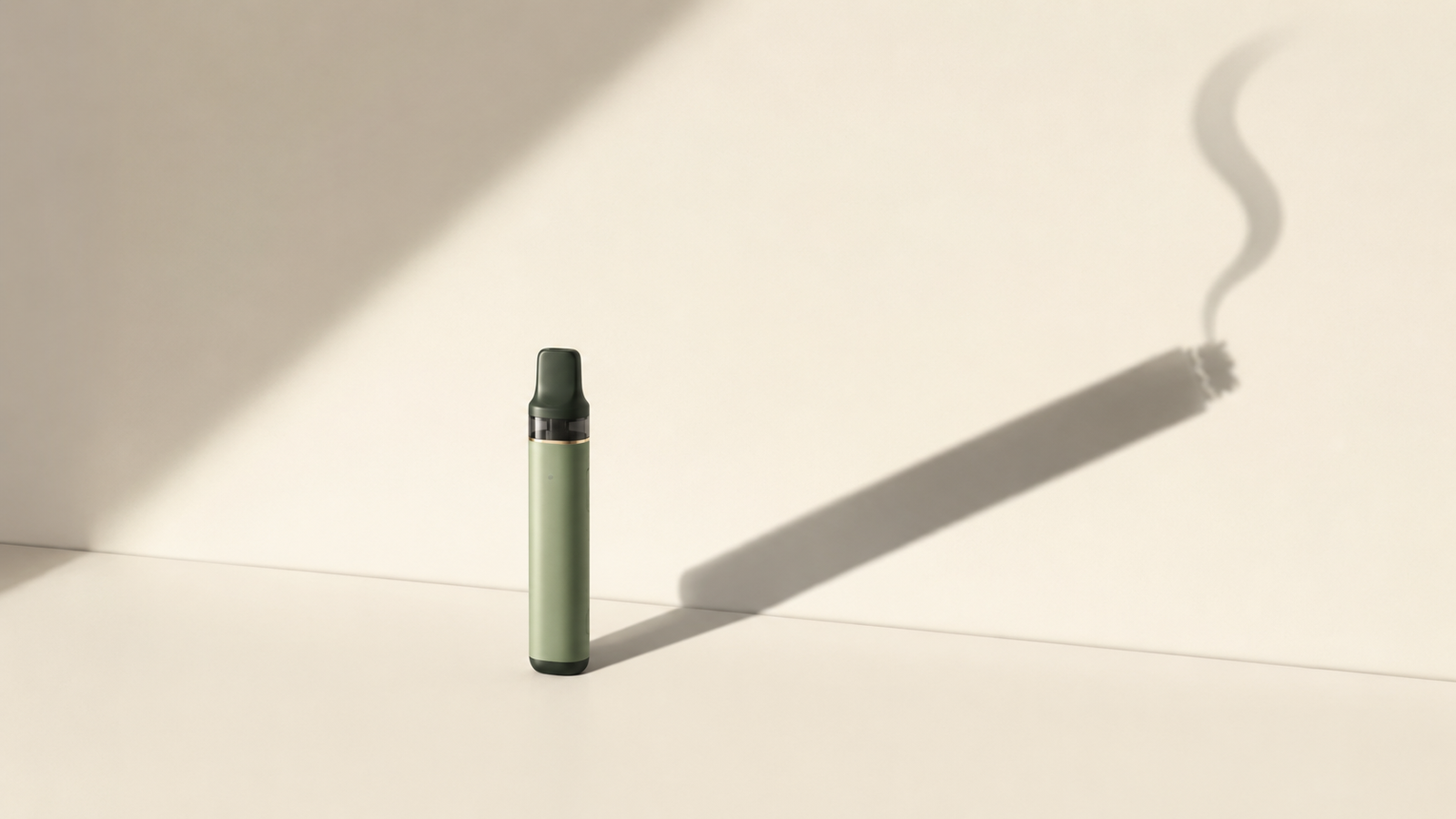
Vaping is hard to quit for a reason that has nothing to do with willpower: it never announced itself as an addiction. No smell, no ash, no packet to count — so the dose arrives in a hundred small hits across the day and your brain never gets a clean "that's finished" signal. Most pods also use nicotine salts, which deliver a high dose smoothly, without the harshness that used to cap how much anyone could inhale. Many young vapers take in more nicotine per day than they ever would have from cigarettes. Quitting in seven days means dismantling the belief that it didn't count.
You were never going to become a smoker. That was the point. No smell on your clothes, no ash, no packet — just a sleek device, a flavour you like, and a thing you do sometimes. Not a habit. Not really.
Read that last part again, because it's the exact sentence that has you checking your pocket for the device right now.
Vaping is harder to quit than most people expect, and it's harder for a specific reason: it never announced itself as an addiction. A cigarette smells, stains, and coughs — it reminds you what it is. A vape slips in quietly, all day, in flavours designed to feel like anything but a drug. By the time you want to stop, you're not fighting a habit you chose. You're fighting one you were told didn't count.
Why vaping gets its hooks in deeper
The nicotine loop is identical to a cigarette's. What's different — and worse — is the delivery.
It never stops. A cigarette has a beginning and an end; you finish it and put it away. A vape has no end. You take three pulls at your desk, two in the lift, one before you sleep. The drug arrives in a hundred tiny doses a day, so your brain never gets the clean "that's over" signal — it just learns that nicotine is always one breath away.
The dose is often bigger. Most pods use nicotine salts, which deliver high nicotine smoothly, without the harshness that used to cap how much someone could inhale. Many young vapers are taking in more nicotine per day than they ever would have from cigarettes — while believing they're doing something lighter.
It hid behind good intentions. A lot of people started vaping to get off cigarettes, or because "at least it's not smoking." That origin story is the trap. It lets the habit keep a clean conscience while the dependency does exactly what a cigarette's would.
The India problem: you're on your own
If you've searched for help, you've noticed there isn't much. E-cigarettes and vapes have been banned in India since the 2019 PECA law — no legal retail, no regulated products, and almost no mainstream quit-vaping support built for the people who use them anyway.
So the vaper who wants to stop is stuck between a grey-market device that's easy to get and a support system that pretends the device doesn't exist. That gap is exactly what a quit-vaping app built for India is for — and it's why we built the Nicoxit method to work for vapers, not just smokers.
Quitting vaping is a belief problem, not a willpower problem
Here's the part that changes the whole approach. The physical nicotine dependency is real, but modest — nicotine clears your system in roughly 72 hours. What keeps you reaching for the device three weeks later isn't the chemical. It's a small stack of beliefs — and vaping has its own set.
- "It's not really smoking." The founding belief. It let the habit form without resistance, and it's still doing that work.
- "It's just flavour." The flavour is the marketing. The nicotine is the product.
- "It's helping me cut down." Often it's helping you top up — everywhere, all day, invisibly.
- "I can stop whenever — it's not that serious." The belief that guarantees you never test whether that's true.
These are the same kind of borrowed beliefs we map for smokers in the 9 beliefs every nicotine user carries — vaping just wraps them in cleaner packaging. And the ones about calm — "a vape helps me de-stress" — fall apart the same way we show in why the calm is just relief, not relaxation: the device mostly relieves the low-grade withdrawal the last pull created.
If you've tried to stop by sheer willpower and failed, that wasn't weakness. You were using a method built for the wrong problem — the same belief-versus-willpower mistake that traps smokers.
How the 7 days actually work
Seven days isn't a promise that cravings vanish on day eight. It's the time it takes to do the real work: separate the chemical from the beliefs, and dismantle the beliefs one at a time.
- Days 1–2: See the machine. Notice how often you pull on the device, and when. Most vapers are genuinely shocked by the count. You're not quitting yet — just watching.
- Days 3–4: Test the beliefs. Before each pull, name what you expect — "this will relax me," "I'll enjoy this." After, write one honest line about what it actually delivered. Ten of those and the belief stops arguing back.
- Day 5: See what it cost — and what recovers. Your body starts repairing within hours of the last pull; taste and smell come back within days. (We'll cover this hour by hour in the next post.)
- Days 6–7: Lock it in with structure, not motivation. You write "if X, then Y" plans for your specific triggers — "if I reach for my pocket after lunch, then I take three slow breaths and a glass of water." This one technique — implementation intentions — does measurable work in smoking specifically — people who made a plan like that quit at roughly twice the rate of those who didn't. When the urge lands, you don't negotiate. You execute.
This is the same acceptance-based, notice-don't-obey approach that outperformed a standard self-help app in a 2014 pilot — 13% abstinent against 8%, in a trial too small to call the difference conclusive — adapted, day by day, for the vape in your pocket.
The one practical move that matters most
Vaping's superpower is access — the device is always right there. So the single highest-leverage change is to break the reach. Take the device out of your pocket, off your desk, off the bedside table. Put it somewhere that requires a decision to retrieve. You're not relying on willpower; you're adding four seconds of friction, which is exactly enough time for the awareness you built in days 1–4 to catch the belief before it acts.
The position this post defends
The vape sold you one idea above all others: that it was never really a habit, so it never really needed quitting. That's the trick. Once you see it as what it is — a nicotine dependency in cleaner packaging — the beliefs come apart, and seven focused days is enough to start.
The vape convinced you it was never really a habit. That's the whole trick.
Want to know which belief has the strongest hold on you? Take the 1-minute Quit Profile quiz, and your personalised plan lands in your inbox the morning we launch.
Related reading :
- Why You Can't Quit Smoking (It's Not Willpower)
- 9 Borrowed Beliefs Every Smoker Carries
- Is Smoking Really Relaxing? The Science Says No
References
- McWilliams, L., Bellhouse, S., Yorke, J., Lloyd, K., & Armitage, C. J. (2019). Beyond "planning": A meta-analysis of implementation intentions to support smoking cessation. Health Psychology, 38(12), 1059–1068. https://doi.org/10.1037/hea0000768
- Bricker, J. B., et al. (2014). Randomized, controlled pilot trial of a smartphone app for smoking cessation using Acceptance and Commitment Therapy. Drug and Alcohol Dependence, 143, 87–94. https://doi.org/10.1016/j.drugalcdep.2014.07.006
Frequently asked questions
How long does it take to quit vaping?
The physical withdrawal is the short part — sharpest in the first three days, easing over the first month. What takes longer is unlearning the cue, because vaping usually spreads across the whole day rather than sitting in discrete breaks.
Is vaping harder to quit than smoking?
Often, for two structural reasons. Vapes allow constant low-level dosing rather than fixed breaks, so more of your day carries a trigger. And many devices deliver nicotine as a salt, which is smoother to inhale and easy to use more of without noticing.
How do I quit vaping in India?
India's Prohibition of Electronic Cigarettes Act, 2019 bans the sale, production and import of e-cigarettes, so there's no regulated cessation pathway aimed at vapers and no legal retail supply to taper from. In practice that leaves behavioural methods, with a doctor or pharmacist if you want NRT.
Can you quit vaping cold turkey?
You can, and some people do. The difficulty isn't the three days of withdrawal — it's that nothing about your reasons for vaping has changed by day four. Cold turkey tests endurance; it doesn't address why the device felt necessary.