
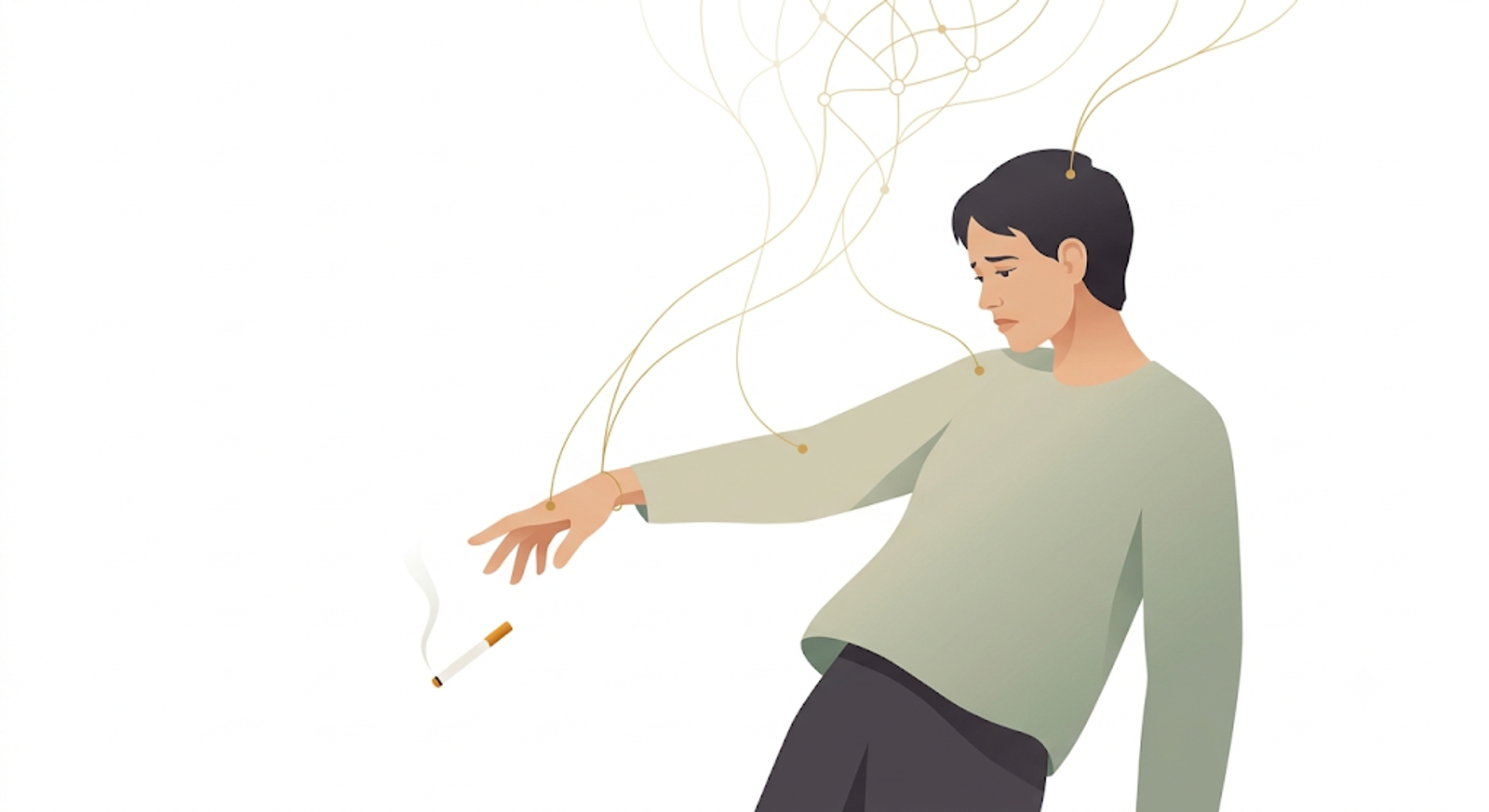
Most people can't quit smoking because they're treating it as a willpower problem when it's a belief problem. Willpower is state-dependent attention — it moves with stress, sleep and blood sugar — so any method that needs you at your best every hour will eventually fail on an ordinary bad day. The beliefs underneath the cigarette — that it relaxes you, that you need it to focus — are what keep the habit running, and unlike willpower they can be examined and dropped. Relapse comes fast: a review of people quitting unaided found most relapse within the first eight days (Hughes et al., 2004).
Why You Can't Quit Smoking (It's Not Willpower)
You haven't failed at quitting. You've been solving the wrong problem.
You've tried before. Maybe two days. Maybe a week. Once, you made it eleven days, and then there was a fight, or a long meeting, or a friend at the chai stall, and you took the stick from his hand and told yourself this was the last one. You believed it when you said it.
It wasn't the last one. None of them were.
If that pattern is familiar, the most important thing to know is that you didn't fail because you were weak. The method failed because it was built on a category error. Willpower isn't the muscle you need. The muscle you need is belief examination — and almost no quit-smoking advice in India is teaching it.
The willpower frame is wrong
When people fail at quitting, they almost always blame themselves. "I didn't want it badly enough." "I have no self-control." "Other people can do it, so what's wrong with me?"
This frame is so embedded in how the conversation works that it feels obvious. It isn't. Willpower — as psychologists actually use the term — isn't a fixed reservoir of character. It's state-dependent attention: your ability to hold a goal in mind while ignoring an impulse, which fluctuates with stress, sleep, blood sugar, and social context.
Cravings arrive 20–50 times a day for a regular smoker. You will, eventually, be tired or stressed or hungry at the exact moment a craving lands. The willpower frame asks you to win a fight you weren't built to win on demand.
The frame is the problem.
What's actually happening when you reach for it
The craving you feel isn't a chemical signal screaming "I need nicotine." It's a prediction your brain is making — based on a belief — about what the next minute will be like with the cigarette versus without it.
After a difficult conversation, the belief is "this will calm me down." Between meetings, the belief is "this will give me a break." At the hookah parlour on Saturday, the belief is "this is what relaxing with friends looks like." The vape pulled in a bathroom stall at work — "nobody will know, and it's not really smoking."
These beliefs are the structure that keeps the pattern in place. The chemical pull of nicotine is real, but it's modest. It clears your system in roughly 72 hours. The belief that the cigarette is doing something for you — calming you, helping you focus, marking the end of a meal, anchoring your identity — is what keeps you reaching for the next one three months after the chemical has gone.
This is the part most quit-smoking advice misses. The most-repeated phrase in smoker support groups isn't about chemistry. It's about identity: "It's become a part of me."
Why NRT and substitution don't end the dependency
Nicotine replacement therapy — patches, gum, lozenges — works on the chemical side of the problem. It keeps your blood nicotine level steady so the physical withdrawal eases. These are useful tools. They are not solutions.
The reason millions of people complete a 12-week NRT course and still relapse within a year is the same reason willpower fails: the belief structure underneath the habit was never examined. You stopped getting nicotine from a cigarette. You replaced it with nicotine from a patch. And the day you take the patch off, the original belief — "I need something to get me through stress" — is still sitting where you left it, waiting for the next stressful Tuesday.
NRT is a bridge. The question is what you're walking towards on the other side.
This is also why switching forms almost never ends the dependency. Cigarettes to vape. Vape to IQOS. Hookah on weekends because "it's only on weekends." The form changes. The belief doesn't. Your brain doesn't know what day of the week it is, or which form arrives. It just knows the chemical.
The four families of belief that keep you stuck
In our research and in the academic literature, the beliefs that hold smokers in place fall into roughly four families. You don't carry all of them. Most people carry two or three.
Biological beliefs. "It calms me down." "It helps me focus." "My body needs it." These feel like physical facts because they've been reinforced thousands of times. They're predictions, not facts. When tested honestly, they don't survive.
Cultural beliefs. "It's what adults do." "It's part of being a man." "It's what high-pressure work looks like." You didn't choose these; you absorbed them — from cinema, from older cousins, from the first year in a hostel where everyone smoked. They feel like personal truth and they are borrowed.
Social beliefs. "My friends all smoke." "It's how we hang out." "If I quit, I lose the circle." Quitting feels like leaving not a substance but a group. In India this often shows up as the loose-cigarette pack-share — you're not buying nicotine, you're buying belonging.
Identity beliefs. "I'm a smoker." "I've always been someone who smokes." "It's part of who I am." The deepest layer. This is the belief that produces the line you've probably said in the mirror.
None of these are addressed by willpower, and only the first is touched by NRT. The cultural, social, and identity beliefs sit untouched in every quit-smoking method built around chemicals or counters. They are the reason quit rates collapse at month two, month six, month thirteen.
What the research actually says works
The methods that produce durable quit outcomes share three features.
They examine the belief, not just the chemical. Acceptance and Commitment Therapy approaches — which teach you to observe cravings as passing mental events rather than commands to be obeyed — outperformed standard self-help in an app-based pilot trial: 13% still abstinent against 8% (Bricker et al., 2014). It was a small trial and the gap didn't reach statistical significance, so read it as a promising direction rather than a settled number. Mindfulness-based approaches teach the same skill. Being straight about the evidence there, though: a 2022 Cochrane review of 21 trials found no clear benefit from mindfulness-based programmes as a way of quitting, and rated its own certainty low to very low (Jackson et al., 2022). The craving skill is worth having. The programmes built around it haven't yet shown they beat the alternatives.
They use structure, not motivation. Implementation intentions — the simple technique of writing "if X happens, then I will Y" in advance — do measurable work in smoking specifically: pooling the trials that tested them, people who made a specific if-then plan quit at roughly twice the rate of those who didn't — 10.7% against 4.9% (McWilliams et al., 2019) — though the trials varied a lot in how they were run. When the craving arrives, you don't think. You execute.
They reframe relapse as data, not verdict. Every durable method treats the day you smoke after quitting as information about which belief is still active — not as proof of failure. Programmes that use shame, streak resets, "back to Day 0" messaging, produce the highest dropout rates in the literature.
If you have tried to quit and failed, you almost certainly used a method that scored well on willpower and badly on belief. That isn't your fault. It's the design.
The position this post defends
Nicoxit is built around one position: quitting nicotine is a belief problem, not a willpower problem — and almost no method in India is teaching it that way.
Patches replace the chemical. Belief is what kept you reaching.
Seven days. The beliefs returned. The destination reached.
If you want to be the first to know when the app goes live, take the 3-minute [What's Your Quit Profile?] quiz — your personalised plan arrives in the inbox the morning we launch.
Whatever you decide, please drop the willpower frame. You were never weak. You were just trying to win the wrong fight.
Related reading
- 9 Borrowed Beliefs Every Smoker Carries
- Is Smoking Really Relaxing? The Science Says No
- Quit Vaping in 7 Days — A Guide for Young Adults
- Our Method: How the 7-Day Course Works
References
- Bricker, J. B., et al. (2014). Randomized, controlled pilot trial of a smartphone app for smoking cessation using Acceptance and Commitment Therapy. Drug and Alcohol Dependence, 143, 87–94. https://doi.org/10.1016/j.drugalcdep.2014.07.006
- Jackson, S., Brown, J., Norris, E., Livingstone-Banks, J., Hayes, E., & Lindson, N. (2022). Mindfulness for smoking cessation. Cochrane Database of Systematic Reviews, CD013696. https://doi.org/10.1002/14651858.CD013696.pub2
- McWilliams, L., Bellhouse, S., Yorke, J., Lloyd, K., & Armitage, C. J. (2019). Beyond "planning": A meta-analysis of implementation intentions to support smoking cessation. Health Psychology, 38(12), 1059–1068. https://doi.org/10.1037/hea0000768
- Lindson, N., et al. (2023). Pharmacological and electronic cigarette interventions for smoking cessation in adults: component network meta-analyses. Cochrane Database of Systematic Reviews, CD015226. https://doi.org/10.1002/14651858.CD015226.pub2
- Hughes, J. R., Keely, J., & Naud, S. (2004). Shape of the relapse curve and long-term abstinence among untreated smokers. Addiction, 99(1), 29–38. https://doi.org/10.1111/j.1360-0443.2004.00540.x
Frequently asked questions
Why can't I quit smoking even though I want to?
Because wanting to quit and believing you'd lose something by quitting can both be true at once. Willpower is the attempt to override the second with the first. It works while you're paying attention and fails when you stop — which isn't a character flaw, it's the design.
Is quitting smoking about willpower?
Not mainly. Willpower is a finite resource applied against a belief that hasn't changed. A review of people quitting unaided found most relapse happens within the first eight days (Hughes et al., 2004) — a pattern that says more about the method than about the people using it.
Does nicotine replacement therapy cure the dependency?
It treats the chemical half well: a 2023 Cochrane analysis found a nicotine patch alone raises the odds of quitting by about 37%. What it doesn't do is change what you believe a cigarette gives you. When the taper ends, that belief is unchanged and still active.
What actually works for quitting smoking?
The strongest evidence sits with behavioural approaches plus support — acceptance-based methods, craving skills, and specific if-then plans for known triggers. Pooling the smoking trials of if-then planning, people who made one quit at roughly twice the rate of those who didn't: 10.7% against 4.9%.