
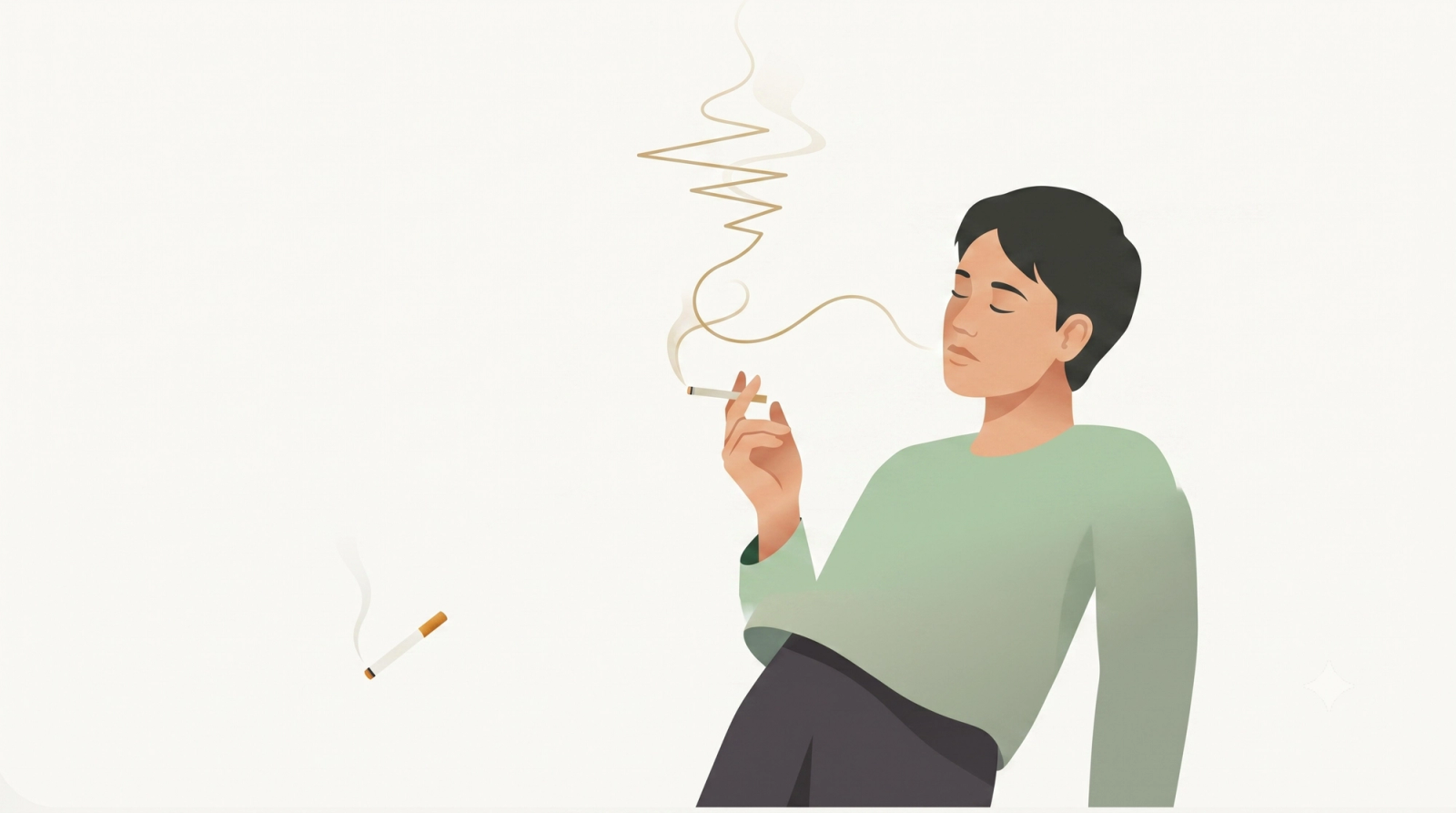
No — smoking doesn't relax you. It relieves a discomfort that smoking itself created. The lift from a cigarette fades within minutes, while the nicotine clears far more slowly — a half-life of about two to three hours — and well before it's gone, a low, restless tension starts building. That's the early edge of withdrawal, and it's exactly what the next cigarette appears to fix. Smokers report higher average stress than non-smokers, and stress falls rather than rises after quitting (Parrott, 1999). Relief and relaxation feel almost identical in the body. They are opposites in what they mean.
The cigarette after a hard day feels like relief. Genuinely. You step outside, the first pull lands, your shoulders drop half an inch. You are not imagining that. Nobody is going to tell you the feeling isn't real.
But relief is not the same as relaxation, and the difference is the whole story. Relaxation is being given something — calm you didn't have before. Relief is having something taken away — a discomfort that was sitting on you a moment ago. They feel similar in the body. They are opposites in what they mean.
So the honest question isn't "does the cigarette feel good?" It does. The question is: what was the discomfort it just relieved — and where did that discomfort come from?
The itch you keep scratching
Think about a mosquito bite. You know you shouldn't scratch it — you've learned that scratching spreads the itch and guarantees it comes back worse. But the itch is right there, insistent, and scratching takes no effort at all. So you scratch.
For about two seconds, the relief is real. Almost disproportionately satisfying. Then the itch returns, worse, and you scratch again. Relief, worse itch, scratch, relief, worse itch. You know the loop even while you're inside it.
That satisfaction when you scratch isn't pleasure. It's the brief interruption of a discomfort that the scratching itself is keeping alive. The only way the bite actually heals is to leave it alone — and within a few days it's gone, and you never have to scratch it again.
Every cigarette is a scratch. The relief is real. But it's relief from a discomfort that only exists because you're still scratching.
The need was installed
Here's the part that's harder to see from the inside, because the craving genuinely feels like a real need, not a habit.
Picture your phone hitting five percent battery with no charger nearby. A specific, rising unease. An urgency that feels completely real — and is completely out of proportion to what's actually happening. That feeling is genuine. It demands a response.
But twenty years ago, nobody felt it. The feeling didn't exist, because the phone created the need and then made itself the only thing that answers it. Every charge just brings you back to the level the phone itself demands. You're not getting ahead. You're returning to zero.
Nicotine works the same way. Before your first cigarette, you never once felt the urge for one. That specific discomfort simply wasn't part of your life. Nicotine created it — and now nicotine appears to fix it. But it's fixing a problem it caused.
This is why a non-smoker sitting next to you at the same stressful moment doesn't need to step out for a cigarette. Not because they have more discipline. Not because they're calmer by nature. Because their phone is always at full charge. The calm you're chasing with the cigarette is the baseline they're already sitting at, for free, all day.
What the science actually found
Here is the finding that surprises people most, and it's where the "science says no" lives.
If smoking genuinely relaxed people, smokers as a group should be calmer than non-smokers. They are not. Research on smoking and stress — most associated with the psychologist Andy Parrott — found that adult smokers report higher average stress levels than non-smokers, and that their stress tends to fall after they quit, not rise (Parrott, 1999). The daily pattern people read as "smoking keeps me calm" is, measured carefully, the opposite: repeated small stress spikes between cigarettes, each one briefly relieved by the next.
What's happening is that the lift from a cigarette fades within minutes, while the nicotine itself clears far more slowly — a half-life of about two to three hours. Well before it's gone, a low, restless, slightly irritable tension starts building: the early edge of withdrawal. The next cigarette clears that tension, and your brain records the event as "the cigarette calmed me down." It did — but only back to the level a non-smoker never left. You feel relaxed relative to the withdrawal. You are not relaxed relative to a life without nicotine.
So the smoker spends the day riding a small saw-tooth: dip into withdrawal, top up, dip, top up. The tops feel like relief. The dips feel like stress. And the whole wave is the drug's doing.
Why it feels truest exactly when life is hardest
This is the cruel part of the design. The cigarette feels most relaxing right after a genuinely stressful event — the difficult call, the fight, the deadline. That timing is what makes the belief so unshakable.
But look at what actually changed. After the difficult call, you smoke, and you feel steadier. Is the problem from the call resolved? No. The email you're dreading is still unsent. What got relieved was the nicotine craving that happened to be peaking at the same time. Two different discomforts — real stress and withdrawal — arrived together, and the cigarette only touched one of them. Your brain gave it credit for both.
Stack that up over years and you get a belief that feels like bedrock: "I need this to cope." What you actually built was a coping tool that adds a second, chemical stress on top of every real one — and then charges you for briefly removing the stress it added.
What's real underneath it
Some of what you'd miss isn't the nicotine at all, and it's worth being honest about that. The cigarette is often the only permission you give yourself to stop — to step outside, put the phone down, breathe, be alone for four minutes. That pause is real, and it genuinely helps. But you'd get the same reset from the walk, the breath, and the four minutes without the drug attached. The nicotine has just been taking credit for the break, the same way it takes credit for the calm.
That's good news, actually. It means the parts that genuinely help you — the pause, the breath, the moment to yourself — are yours to keep. It's only the scratch you're putting down.
How to test this for yourself
You don't have to take any of this on faith. The method is the one we use throughout the Nicoxit course, and it's simple enough to start today.
Before you smoke, name what you expect. Say it plainly: "I believe this will relax me."
After, write one honest line. Not dramatic — just true. "The stress from the meeting is still here. I feel a bit less edgy for a few minutes. Nothing actually got calmer except the craving."
Do that ten times and you stop arguing with the belief and start out-evidencing it, in your own handwriting. That comparison — the promise next to the reality — is the thing no article can install for you and no craving can talk you out of, because you're the one who collected it.
The position this post defends
Nicoxit is built on one idea, and this belief is a clean example of it: the cigarette isn't giving you calm, it's briefly relieving a discomfort it created — and every method that treats the relief as real relaxation is helping you scratch a bite that would heal on its own if you let it.
The calm isn't the cigarette giving you something. It's the cigarette briefly stopping something it started.
If you want to know which belief has the strongest hold on you — "it relaxes me" is one of nine we map — take the Quit Profile quiz, and your personalised plan lands in your inbox the morning we launch.
Related reading (internal links — added as posts publish):
References
- Parrott, A. C. (1999). Does cigarette smoking cause stress? American Psychologist, 54(10), 817–820. https://doi.org/10.1037/0003-066X.54.10.817
- 2. Kim, S., et al. (2025). [Nicotine pharmacokinetics — plasma half-life].
Biopharmaceutics & Drug Disposition. https://doi.org/10.1002/bdd.70018
Frequently asked questions
Is smoking actually relaxing?
No. What you feel is withdrawal ending, not relaxation beginning. Between cigarettes, nicotine levels fall and produce tension; the next cigarette removes the tension it caused and returns you to baseline. You experience that return as calm.
Why does a cigarette feel like stress relief?
Because the timing is convincing. Relief arrives within seconds of the first drag, and your brain pairs it with the cigarette rather than with the withdrawal it ended. Parrott's work described smokers as more stressed than non-smokers, not less.
Do smokers have more stress than non-smokers?
Research indicates yes. Adult smokers report higher stress than non-smokers, and stress tends to fall after quitting rather than rise — consistent with the 2014 BMJ meta-analysis finding lower anxiety, depression and stress among people who quit.
If smoking isn't relaxing, why does it work when I'm upset?
Because a strong emotion makes the withdrawal harder to sit with, so the relief lands harder. The cigarette doesn't address what upset you — it interrupts it. That's a pause, and you can get a pause without the cigarette.