
On the measurements that exist: heated tobacco users show lower levels of some measured toxicants than cigarette smokers, and higher levels than people using no tobacco at all. That's from the 2022 Cochrane review. How confident the reviewers are depends on the marker: moderate certainty for both NNAL and carboxyhaemoglobin against cigarette smoking, and against abstinence, moderate for NNAL but very low for carboxyhaemoglobin. These are exposure measurements, not measurements of disease risk.
Two things that sentence doesn't say, and which matter more than it does. It doesn't say heated tobacco is safe, and it doesn't say it helps you stop smoking. No study in that review measured whether people using it actually quit cigarettes.
And in India, the question is partly settled for you: heated tobacco products are banned.
What heated tobacco actually is
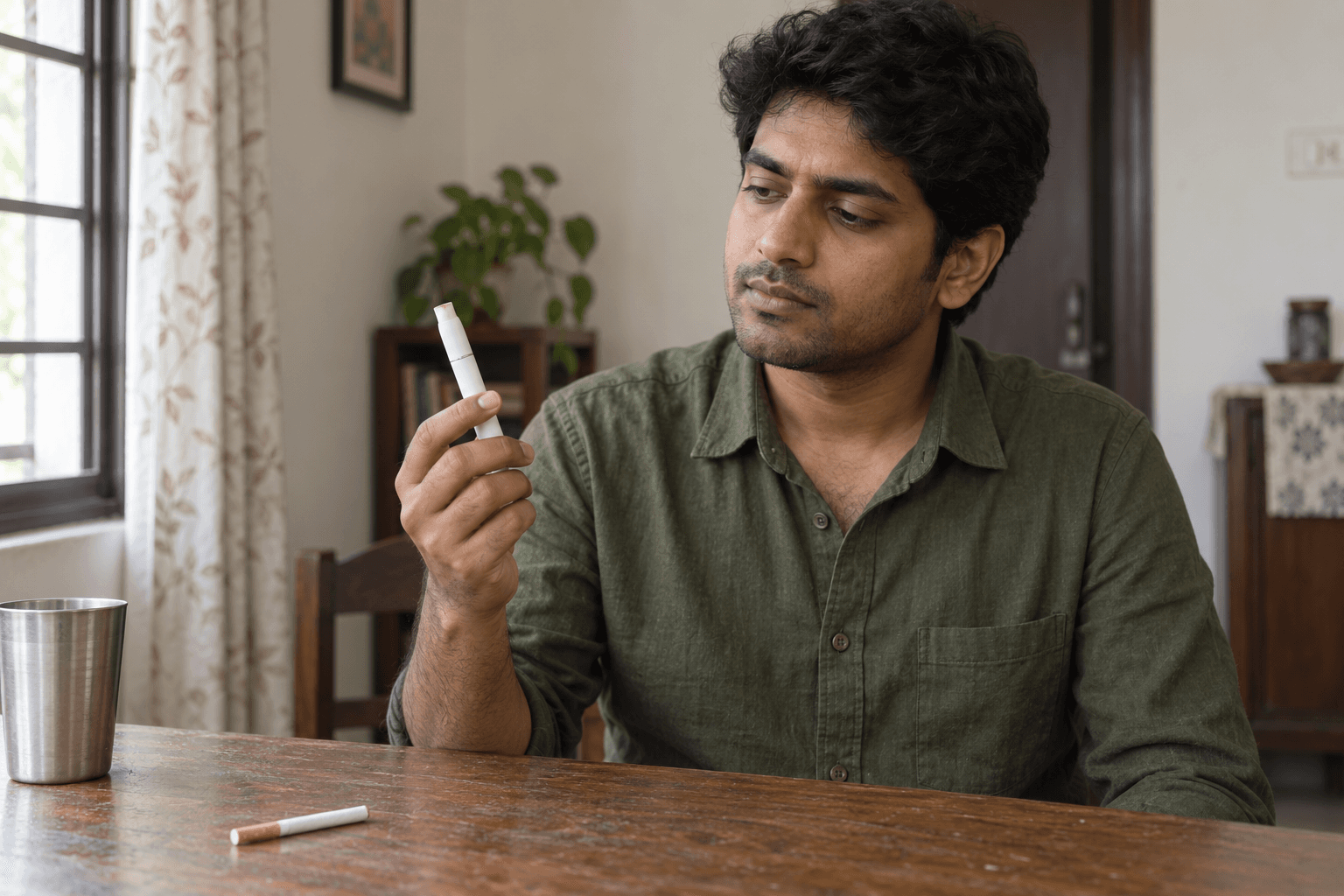
IQOS is the best-known example of a heat-not-burn product. It heats processed tobacco to a temperature high enough to release an aerosol without setting it alight. That's the difference from a cigarette, which burns, and from a vape, which heats a liquid rather than tobacco leaf.
The pitch attached to that engineering is that most of the harm from smoking comes from combustion. That part is broadly right. The question is what follows from it.
What the evidence found
The Cochrane review pulled together 13 studies, including 11 randomised trials with 2,666 people, with evidence current to January 2021.
- Selected toxicant markers, versus cigarettes: lower. NNAL and carboxyhaemoglobin, across 10 studies and 1,959 people, at moderate certainty, limited by risk of bias. That's some measured toxicants, not all of them.
- Versus stopping tobacco entirely: NNAL was higher in the heated tobacco group, across five studies and 382 people, at moderate certainty. The carboxyhaemoglobin comparison came out very low certainty, so it settles less.
- Quitting smoking: no study reported it. Whether heated tobacco helps anyone stop smoking is simply unknown.
- Side effects: not enough evidence to tell whether they differ from cigarettes. The trials were short and imprecise.
- Population level: cigarette sales in Japan fell faster after heated tobacco launched there, at very low certainty, and the reviewers can't say whether one caused the other. A fall in sales also isn't the same thing as a fall in smoking.
- The search stopped at January 2021, so anything published since isn't in here.
One fact about the evidence base itself, which Cochrane records: all 11 of those randomised trials were funded by tobacco companies. That isn't an accusation, and it doesn't make the findings wrong. It's a limitation the reviewers note themselves, alongside a call for independently funded research — worth knowing when a whole literature points one way.
"Reduced exposure" is not "reduced risk"
This distinction is the entire question, and a regulator has already drawn it.
The US FDA has authorised specific marketing claims for certain IQOS products: that the system heats tobacco without burning it, and that this significantly reduces the production of harmful and potentially harmful chemicals. That's an exposure claim, and the authorisation is specific to those products and those words.
The FDA did not authorise a reduced-risk claim, and it says plainly that there is no safe tobacco product. Its authorisation shouldn't be read as a finding that IQOS is safe or that using it lowers your risk of disease.
So the honest formulation is: lower levels of some measured harmful chemicals, over shorter periods than anyone has studied, with the effect on cancer, heart disease, lung disease and mortality unestablished. "Safer" compresses all of that into a word that does a lot of quiet work.
Where India stands
The Prohibition of Electronic Cigarettes Act, passed in December 2019, defines electronic cigarettes broadly enough to include heat-not-burn products by name, alongside e-cigarettes and e-hookah.
The ban covers production, manufacture, import, export, transport, sale, distribution, storage and advertisement. Penalties start at up to a year's imprisonment or a fine of up to one lakh rupees, rising for repeat offences. Worth checking against the current legislation and official guidance, since this is the position as we understand it rather than legal advice.
What that means practically: the activities that would put a device in your hands are the ones the Act prohibits. Where any particular device came from isn't something we can tell you, and questions about your own legal position belong with a lawyer. But availability and legality are part of the answer to "should I switch to this."
The part the device doesn't change
Heated tobacco delivers nicotine, which can keep dependence going. And whatever it does to combustion, the pause, the trigger, the routine and the belief that the moment needs something in your hand can all survive the switch — though how much of that persists differs from person to person.
Some people who switch describe it as having half-quit. Our view, not a research finding: changing the delivery method doesn't necessarily address the reasons you reach for it. Worth being clear that nicotine replacement is a different proposition — it's designed to supply nicotine without tobacco smoke and is used inside evidence-based cessation, which heated tobacco is not. The point the two have in common is narrower: neither one is aimed at the beliefs and routines, and that's where behavioural work comes in.
Where Nicoxit comes in
Cigarettes, vapes, hookah, IQOS. The course covers all four, because your brain doesn't know the difference between them — same loop, different delivery.
We don't replace the nicotine. We dismantle the reason you reach for it. Which is why swapping devices isn't the route we'd point you to.
31 modules, about 40 minutes a day, 22 exercises and 7 tools, across seven days. A course, not a tracker. You keep smoking during the programme, whatever form that smoking currently takes.
Day 1 is free — modules 1 to 3, if you want to test the approach first.
The position this post defends
Heated tobacco shows lower levels of some measured harmful chemicals than a cigarette, and higher levels than not using tobacco. No eligible study measured whether it helps anyone stop smoking. Its trial evidence was funded by the industry selling it, and in India it's illegal to sell or import.
"Is it safer than cigarettes" turns out to be the wrong question, because the honest answer is lower on some measures than the worst available option, with the long-term implications unknown. The comparison that matters is with not using tobacco at all — and there, for NNAL at least, exposure is higher.
Want to see which belief keeps the device in your hand? Take the 3-minute Quit Profile quiz — a reflection tool, not a clinical assessment.
Related reading:
- Quit Vaping in 7 Days — A Guide for Young Adults
- Is Hookah Safer Than Cigarettes? What Every Weekend Smoker Should Know
- Do Nicotine Patches Actually Work? What the Evidence Says
- What Happens When You Quit Smoking — Hour by Hour
References
- Tattan-Birch, H., Hartmann-Boyce, J., Kock, L., Simonavicius, E., Brose, L., Jackson, S., Shahab, L., & Brown, J. (2022). Heated tobacco products for smoking cessation and reducing smoking prevalence. Cochrane Database of Systematic Reviews, 1, CD013790. https://doi.org/10.1002/14651858.CD013790.pub2
- US Food and Drug Administration. Philip Morris Products S.A. modified risk tobacco product (MRTP) applications. https://www.fda.gov/tobacco-products/advertising-and-promotion/philip-morris-products-sa-modified-risk-tobacco-product-mrtp-applications
- Prohibition of Electronic Cigarettes (Production, Manufacture, Import, Export, Transport, Sale, Distribution, Storage and Advertisement) Act, 2019 (Act No. 42 of 2019), Government of India. https://www.indiacode.nic.in/handle/123456789/13078
Frequently asked questions
Is IQOS safer than smoking cigarettes?
The 2022 Cochrane review found moderate-certainty evidence that heated tobacco users had lower levels of certain measured toxicants than cigarette smokers. That doesn't establish that exposure to every harmful substance is lower, and lower exposure is not the same as lower disease risk, which hasn't been established. Compared with using no tobacco at all, NNAL was higher.
Does IQOS help you quit smoking?
Unknown. No study in the Cochrane review measured whether people using heated tobacco stopped smoking cigarettes.
Is IQOS legal in India?
No. The Prohibition of Electronic Cigarettes Act 2019 includes heat-not-burn products in its definition, and bans their production, import, sale, distribution, storage and advertising.
Has the FDA approved IQOS as safe?
No. The FDA has authorised specific marketing claims for certain IQOS products, about heating rather than burning tobacco and the reduction in harmful chemicals that follows. It did not authorise a reduced-risk claim, and it states there is no safe tobacco product.
Is heated tobacco addictive?
It delivers nicotine, which can maintain or reinforce dependence. Dependence is shaped by how much nicotine you take in, how often, and by withdrawal and individual factors. Changing the delivery system doesn't necessarily remove it.