
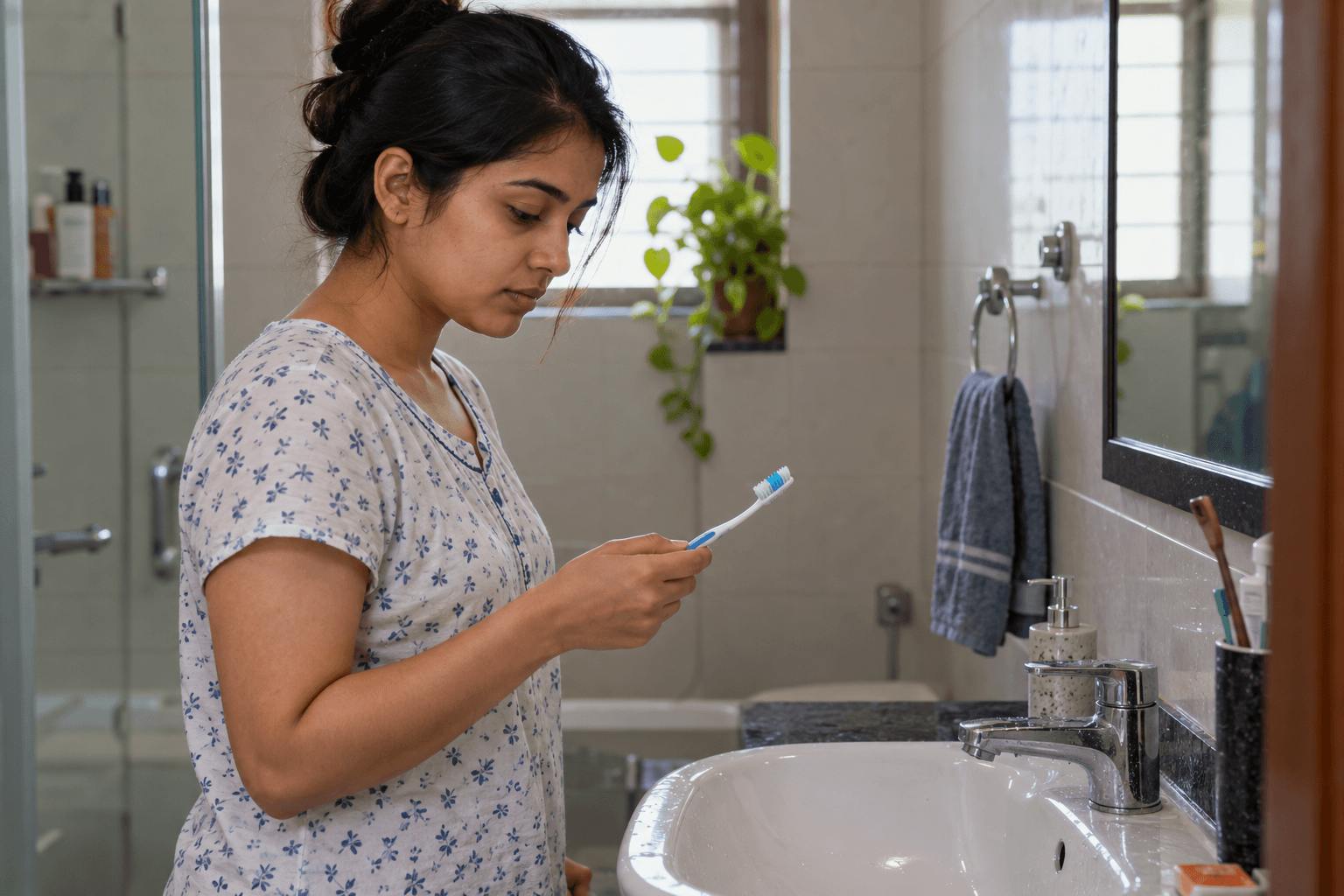
The staining is the part you can see, and it is the part that matters least. The gum tissue underneath is where smoking does the damage that does not come off with a toothbrush.
Most people arrive at this subject through the mirror, the same way they arrive at hair. Yellowing, darkening between the teeth, a change in colour that whitening toothpaste makes a small dent in. That is a cosmetic problem with cosmetic solutions, and it is worth separating from the clinical one immediately, because they behave completely differently when you stop.
What quitting actually changes, and when
A 2026 systematic review and meta-analysis in Frontiers in Oral Health looked specifically at what happens to periodontitis when people stop smoking. It pooled six prospective studies covering 1,934 people, comparing those who quit against those who continued.
The main measure was probing depth, the distance from the gum margin to the base of the periodontal pocket. A second measure, clinical attachment loss, tracks loss of the supporting tissue around the tooth. The two are related, but they are not interchangeable.
Quitting was associated with improvement in probing depth at three months (standardised mean difference -1.08, 95% confidence interval -1.84 to -0.31) and at six months (-1.50, -2.45 to -0.55), and with improvement in clinical attachment loss at three months (-0.78, -1.39 to -0.16).
Those figures need their context, and it is not the context the headline numbers suggest. The probing-depth analysis pooled four of the six studies, covering 326 people, and the attachment-loss analysis three studies covering 227. Every one of these results is rated very low certainty by the review's own GRADE assessment, and the studies disagree with each other a great deal: in these two analyses, heterogeneity runs from 78% to 98%. Read them as a weak signal rather than a measurement.
Then the honest part. Clinical attachment loss was not significantly associated with quitting at six months or at twelve, and probing depth was not at twelve. The review found no statistically significant association between quitting and either bleeding on probing or plaque index at any follow-up point. The authors' own conclusion is that smoking cessation may be associated with modest short-term improvements, and that longer, higher-quality studies are needed to establish clinical relevance.
One thing is worth knowing about that last pair of measures. Smoking can suppress bleeding on probing, so an absence of bleeding does not necessarily indicate healthy gums. That is a general point about what the measure can hide. It is not the explanation for this review's findings, and we are not putting it forward as one.
A standardised mean difference is a way of pooling studies that measured the same thing on different scales, expressed in standard deviations rather than millimetres. A value around -1 is a large effect by convention. It is also a statistical summary of six studies, not a prediction about your mouth.
We are reporting the twelve-month result rather than stopping at six because leaving it out would make this article say something the evidence does not support. Six studies and 1,934 people is a small base, and "we do not yet know whether it holds at a year" is the accurate position.
It is worth being careful about what a result that does not reach significance means. It is not a finding that quitting stops helping at a year. A result can fail to reach significance because the effect is not there, or because there is not enough data at that point to detect it, and six studies cannot separate those two. The honest reading is that the evidence thins out, not that the benefit disappears. Absence of a significant result and evidence of no effect are different things, and the authors treat it as the first.
Where vaping sits
In a 2025 systematic review in Health Science Reports covering thirteen studies, cigarette smokers generally had poorer periodontal outcomes than vape users across the included studies. That comparison does not establish that vaping is safe, and findings may differ across oral-health outcomes and study designs. The review's own position is that vaping appears to have less influence on periodontal health and that this needs further examination, which is not the same as a clean bill.
A 2026 review in the International Dental Journal looked at oral health across electronic nicotine delivery systems more broadly and reported higher caries risk, more staining of teeth and restorations, more dry mouth, gingival inflammation, and a greater prevalence of periodontal and peri-implant disease compared with non-users, along with more frequent oral mucosal lesions compared with former smokers. Its summary is that these products appear to affect oral health in ways that differ from conventional cigarettes rather than simply being a milder version of them.
That same review notes high-certainty evidence that e-cigarettes work as a cessation aid, at about four additional quitters per hundred people. Those two findings sit side by side without cancelling each other out, which is the whole difficulty with the vaping question.
The staining question, answered plainly
Extrinsic surface staining can often be reduced by professional dental cleaning. It is a cosmetic issue, and on its own it does not indicate whether the gums or the supporting tissues are healthy. Someone can have very visibly stained teeth and reasonably healthy gum attachment, and someone can have clean-looking teeth and significant bone loss underneath. One does not predict the other.
If your gums bleed when you brush, if they have receded, or if a tooth has started to feel loose, that is a reason to get the gums assessed by a dentist. An article cannot tell you what is happening below the gumline, and the measurements in this one are the kind that require someone with a probe.
Our view, not the reviews'
Here is our argument, labelled because none of the studies above tested it.
Teeth are unusual among the reasons people quit, because the evidence is close enough to touch. Nobody feels their arteries. Most people under thirty do not feel their lungs. But a gum that bleeds when you brush is feedback arriving daily, in a mirror, on a schedule.
We think that is worth more than the effect sizes above, and for a reason the effect sizes actually support rather than undercut. The twelve-month result not holding is not a reason to dismiss the finding. It is a reminder that the useful thing here was never a promise about recovery. It was the fact that this is one of the few consequences of smoking you can watch in something close to real time, which makes it unusually hard to argue with.
What follows from that, for us, is a change in what the mouth is for. It is not a progress bar. It is the one place where the consequences of a habit show up on a timescale short enough to notice, which makes it useful as information rather than as a reward. A change you can see is worth knowing about. So is the absence of one, and that is a reason to get it looked at rather than a reason to conclude the attempt is not working.
Where Nicoxit comes in
Nicoxit is a seven-day journey, 31 modules, built on published behavioural science, covering cigarettes, vapes, hookah and IQOS. It tracks recovery milestones alongside days free and money saved. You keep smoking while you work through it, which is deliberate, and it explains why.
Not medical advice.
References
- Xie, Y., Ma, Y., Geng, Z., Zhao, H., Li, X., Wang, L., Yan, P., Jiang, X., & Zhang, M. (2026). Association between smoking cessation and periodontitis progression: A systematic review and meta-analysis of prospective observational studies. Frontiers in Oral Health, 7, 1900393. https://doi.org/10.3389/froh.2026.1900393
- Aldalaeen, M. O., Haddad, R. H., Alhusamiah, B. K., & Abuejheisheh, A. J. (2025). The impact of cigarette smoking and vaping use on the development and progression of periodontitis: A systematic review. Health Science Reports, 8(9), e71245. https://doi.org/10.1002/hsr2.71245
- Kumar, P. S., Beverly, M. L., Galindo-Fernandez, P., Thompson, W., Verma, M., & Shick, E. (2026). To vape or not to vape: Oral health in the age of electronic nicotine delivery systems and electronic non-nicotine delivery systems. International Dental Journal, 76(3), 109523. https://doi.org/10.1016/j.identj.2026.109523
Frequently asked questions
Does smoking cause gum disease?
Smoking is consistently associated with worse periodontal conditions. In a 2025 systematic review of thirteen studies, cigarette smokers generally had poorer periodontal outcomes than vape users across the included studies.
Do your gums recover after you quit?
A 2026 meta-analysis found quitting associated with improvement in probing depth at three and six months, and in clinical attachment loss at three months. Those pooled results rest on four studies and three studies respectively, are rated very low certainty, and come with high disagreement between studies. The improvements were not sustained at twelve months, and the authors call for longer, higher-quality studies before drawing conclusions about clinical relevance.
Will my teeth get whiter if I stop smoking?
Extrinsic surface staining can often be reduced by professional dental cleaning. It is a separate question from gum health, and neither one predicts the other.
Is vaping better for your teeth than smoking?
Cigarette smokers generally had poorer periodontal outcomes than vape users in the review above, which does not establish that vaping is safe. Separately, a 2026 review reported higher caries risk, more dry mouth, gingival inflammation and greater prevalence of periodontal and peri-implant disease in e-cigarette users compared with non-users. Less harmful than cigarettes on this measure is not the same as harmless.
My gums bleed when I brush. What does that mean?
It is a reason to have them assessed by a dentist. Nothing in this article can tell you what is happening below the gumline.