
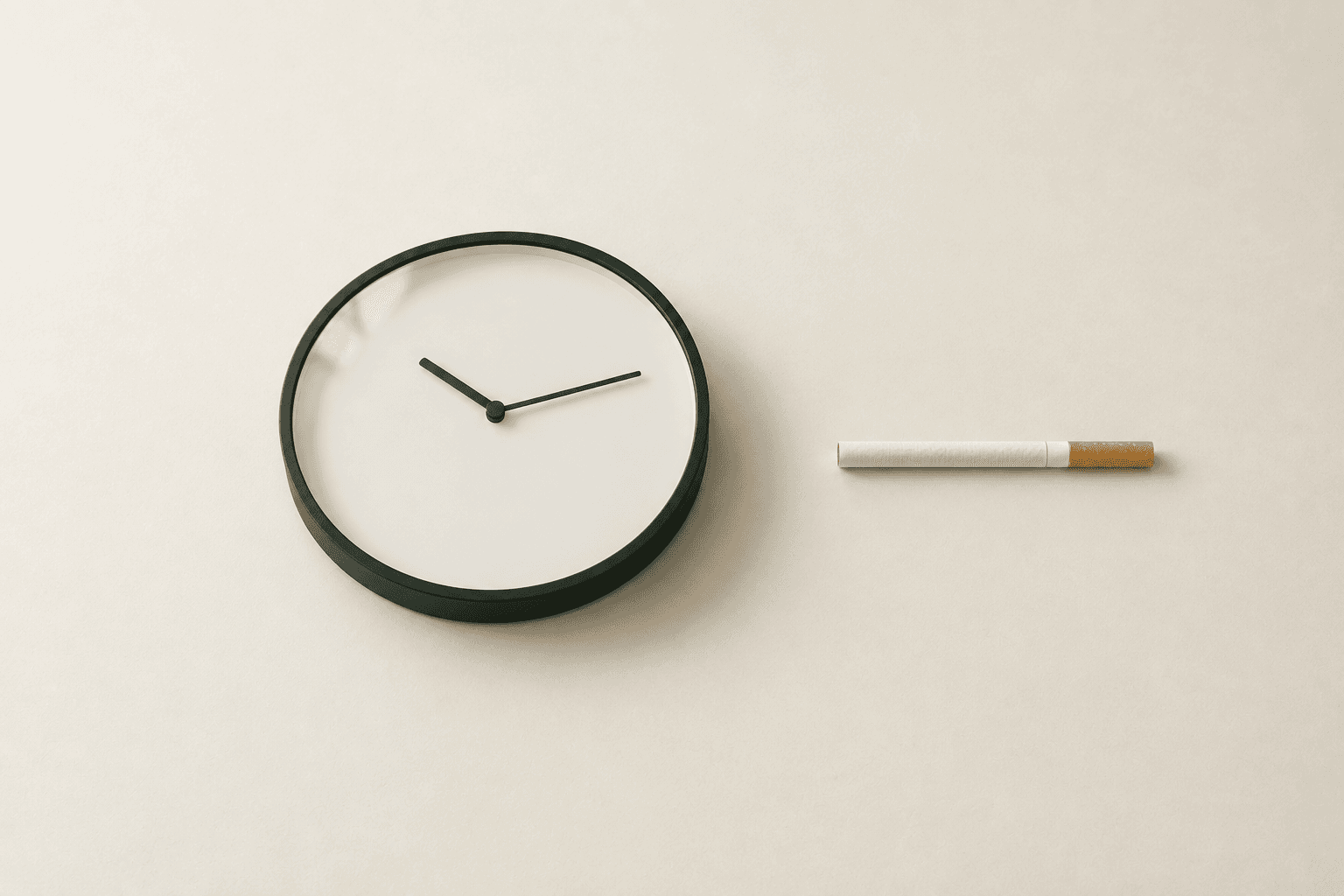
You can stop today, and there's nothing in the evidence that says waiting for a better date would improve your odds. The part almost nobody tells you is that the stopping isn't the hard bit. The next forty-eight hours are.
So here's the sequence, in order, starting now.
The date was never the thing
Most quit advice opens by asking you to pick a day. It's worth knowing how little that step earns.
A Cochrane review pooled 22 trials and 9,219 people comparing two plans — cut down over some weeks and then stop, or stop abruptly on a chosen day. The long-term quit rates came out essentially identical, a risk ratio of 1.01, with a confidence interval from 0.87 to 1.17 and moderate certainty. Neither approach wins. We've written that comparison up in full: cold turkey or cut down.
There's a second finding that goes further, and it's the one that matters if you're reading this at 11pm having decided ten minutes ago. In a household survey of 918 smokers and 996 ex-smokers in England, 48.6% said their most recent quit attempt started the moment they decided — no plan, no date. And those unplanned attempts were more likely to last six months: odds 2.6 times higher, with a confidence interval of 1.9 to 3.6.
Two honest caveats on that one. It's from 2006, and it's a survey rather than a trial, which means it cannot separate "quitting on the spot works better" from "people who are genuinely ready quit on the spot." We keep it because nothing since has tested the same question, and because it is an observation about what people did rather than an estimate of how well a treatment works. That kind of finding doesn't go stale the way trial results do.
Either way, the reading is the same. Deciding now is not the weak version.
The first hour
Do these, in this order, before the decision cools.
Get rid of the physical stock. Pack, lighter, matchbox, the spare in the bike, the one in the drawer. All of it, now, not tomorrow morning. Not because a cigarette is hard to buy — it takes four minutes — but because four minutes is exactly the gap you need.
Tell one person. One. Not the group chat. Someone who will hear it without making it a project.
Write down your three. The three moments in a normal day when you reach without thinking. Chai at 11. After lunch. The walk to the metro. Write the actual three, not the generic ones.
That's the hour. It's deliberately small.
The next forty-eight hours
This is where a same-day quit either becomes a quit or becomes a story you tell later.
Don't try not to think about it. This is the most common instruction on the internet and it has a measured failure mode. Smokers told to suppress thoughts of smoking went on to smoke more in the days that followed than those given no such instruction. Pushing the thought away is not neutral. You are rehearsing the thing.
Let the urge arrive and watch it. The alternative to suppression isn't willpower, it's attention. A randomised trial in daily smokers tested training people to notice a craving as a passing event rather than an instruction, targeting the link between the urge and the hand rather than the urge itself — Roos and colleagues, 2023. Urges peak and fall on their own, which is useful to know before your first one rather than after. We've written separately on how an urge differs from a craving and how long they actually last.
Write an if-then line for each of your three. Not a resolution — a sentence with a trigger in it. If it's 11 and the chai comes, then I take it to my desk and finish it there. Across 642 tests, plans of exactly this shape are what closes the gap between intending something and doing it. The point isn't motivation. It's that the moment stops requiring a decision.
Have somewhere for the hands to go. Substitutes solve less than people hope, but the first two days are the one window where they genuinely help.
What stopping immediately cannot do
Here's the part we would rather say out loud than have you find out on day nine.
Stopping today removes the cigarette. It does not touch the reasons you were reaching for it, and those reasons are patient. They wait for a bad afternoon, a drink, a fight, a night when the plan feels theoretical. This is why the same person can quit four times and relapse four times without ever being weak about it.
So if you have already stopped, stay stopped — but treat the coming week as the actual work rather than a waiting period. And if you slip, one cigarette is not the end of the attempt unless you decide it is.
Where Nicoxit comes in
If you want the structure rather than the improvisation, the course runs seven days and it starts from the opposite end: you keep smoking through the first six while you work out what is actually driving the reaching. Then you stop, once, with the map already made.
That is a strange thing to put at the bottom of an article about stopping immediately, and we are not going to pretend otherwise. If you have already stopped today, don't restart to follow a curriculum — run the course alongside the quit you have already begun. The Anchor statement is the written if-then sentence, aimed at whichever of your three is worst. The Identity Tracker is the part that holds, with milestones that never reset, so a slip doesn't take the ground back.
31 modules, seven days, about forty minutes a day. A course first, with the tracker that follows it. Cigarettes, vapes, hookah and IQOS.
Not sure which of your three is the real one? The quiz takes two minutes.
You don't need a better day. You need a plan for Thursday afternoon.
References
- Lindson, N., Klemperer, E., Hong, B., Ordóñez-Mena, J. M., & Aveyard, P. (2019). Smoking reduction interventions for smoking cessation. Cochrane Database of Systematic Reviews, (9), CD013183. https://doi.org/10.1002/14651858.CD013183.pub2
- West, R., & Sohal, T. (2006). "Catastrophic" pathways to smoking cessation: Findings from national survey. BMJ, 332(7539), 458–460. https://doi.org/10.1136/bmj.38723.573866.AE
- Erskine, J. A. K., Georgiou, G. J., & Kvavilashvili, L. (2010). I suppress, therefore I smoke: Effects of thought suppression on smoking behavior. Psychological Science, 21(9), 1225–1230. https://doi.org/10.1177/0956797610378687
- Roos, C. R., Harp, N. R., Vafaie, N., Gueorguieva, R., Frankforter, T., Carroll, K. M., & Kober, H. (2023). Randomized trial of mindfulness- and reappraisal-based regulation of craving training among daily cigarette smokers. Psychology of Addictive Behaviors, 37(7), 829–840. https://doi.org/10.1037/adb0000940
- Sheeran, P., Listrom, O., & Gollwitzer, P. M. (2025). The when and how of planning: Meta-analysis of the scope and components of implementation intentions in 642 tests. European Review of Social Psychology, 36(1), 162–194. https://doi.org/10.1080/10463283.2024.2334563
Frequently asked questions
Can I really stop smoking immediately?
Yes. Survey evidence from England found that nearly half of quit attempts began the moment the person decided, with no plan at all, and those attempts were more likely to last at least six months. It is observational rather than a trial, so it cannot prove that immediacy is the cause — but there is nothing suggesting that waiting for a planned date improves your chances.
Is it better to quit smoking suddenly or gradually?
Neither is better. A Cochrane review of 22 trials covering 9,219 people found that cutting down first and stopping abruptly produced about the same long-term quit rate, a risk ratio of 1.01 with moderate certainty. Pick whichever you will actually follow.
What should I do in the first hour after stopping?
Clear out every pack, lighter and ashtray you own, tell one person, and write down the three moments in a normal day when you reach for a cigarette without thinking. Small and specific beats a long list you won't finish.
Why do most same-day quits fail?
Because stopping removes the cigarette without touching the reasons behind it. The reasons resurface on a bad day, usually in the second week. A same-day quit works better when the first week after it is treated as the real work rather than as waiting for cravings to stop.
Does trying not to think about smoking help?
No, and it can backfire. In one experiment, smokers instructed to suppress thoughts about smoking went on to smoke more over the following days than those given no instruction. Noticing the thought and letting it pass is the workable alternative.