
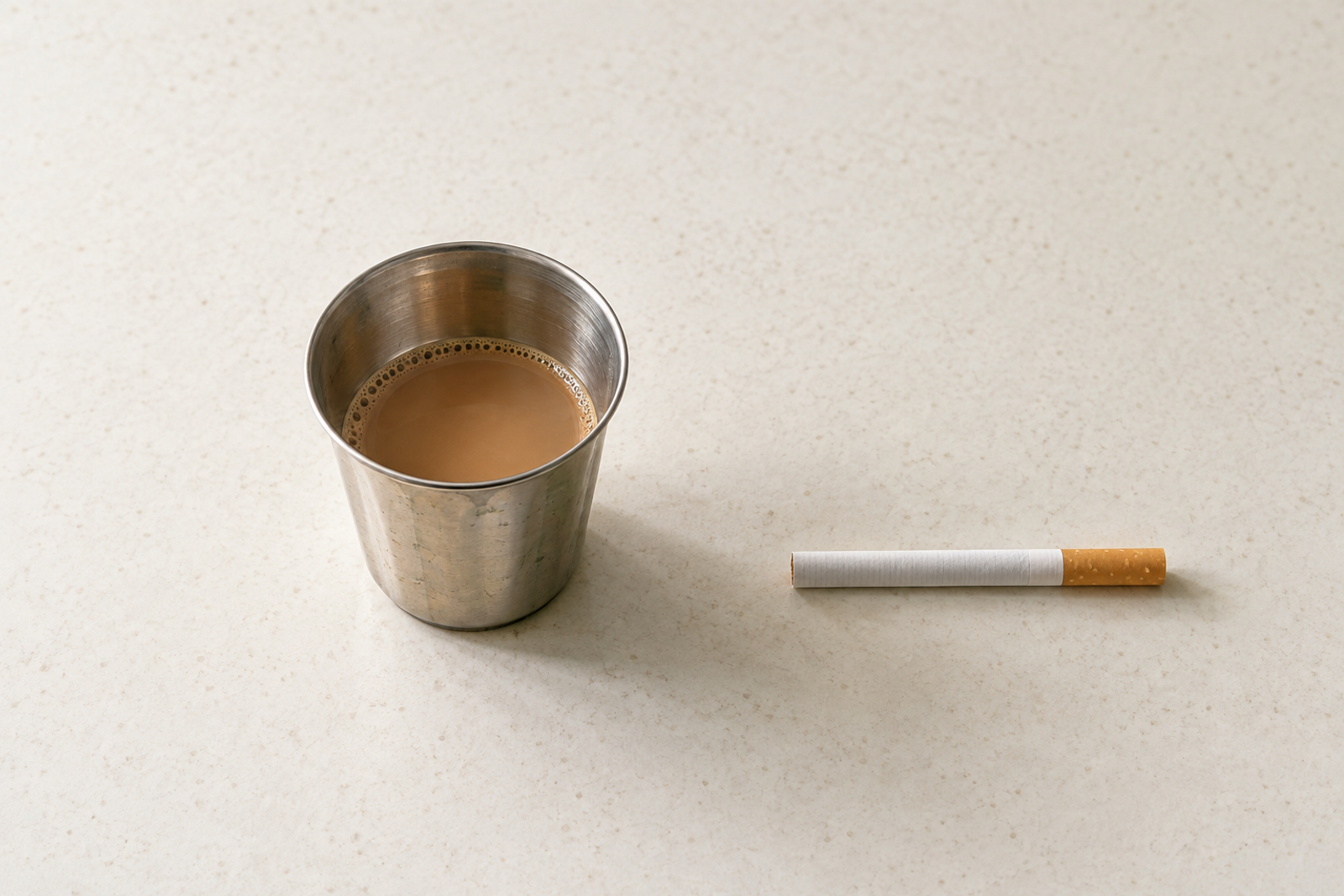
Occupy the gap, don't replace the reward. Every list gives you seeds, gum, a glass of water, a walk — and those help, but only if you understand what they're for. The thing that actually weakens a craving is that it arrived and nothing followed. Anything that stands in as a substitute reward keeps the loop running with a new item in the slot.
Which is why people who switch to something else often find themselves, six weeks later, with the new thing and the old habit.
What the moment actually is
A craving is not a steady state. It arrives, builds, and drops — usually in a few minutes — whether or not you do anything about it. We've written at more length on how long they run and on the gap between the urge and the story you tell about it.
That shape is the whole opportunity. You're not being asked to endure something indefinite. You're being asked to get through a few minutes without the one action you'd normally take — and then, crucially, to have done that, because the doing of it is the part that counts.
So the question isn't what's as good as a cigarette. Nothing on a list of substitutes is. The question is what gets you through four minutes and leaves the cue a little weaker than it found you.
Why distraction alone doesn't hold
The standard advice is to take your mind off it. It half-works, and the half that doesn't is worth knowing about.
Smokers told to actively suppress thoughts of smoking went on to smoke more over the following days than those given no such instruction — Erskine, Georgiou and Kvavilashvili, Psychological Science, 2010. Effortful not-thinking is its own kind of attention. You can keep it up for an evening. You can't keep it up for a month, and the rebound arrives when you stop.
There's a better-supported alternative to fighting the thought, and it's almost the opposite. A randomised trial in daily smokers trained people to notice a craving and let it run rather than act on it, and measured what that does to the link between the urge and the action — Roos et al., Psychology of Addictive Behaviors, 2023. The urge is allowed to be there. What changes is whether it decides anything.
That's a real distinction and it's the difference between an alternative that holds and one that runs out.
What to do instead — by what the moment is
When it's boredom
This is the easiest one and people underrate it. The habit isn't filling a need; it's filling a gap in the schedule — the pause after a task, the ten minutes before the bus, the slot where nothing is happening.
Fill the slot, not the craving. Walk to the end of the lane and back. Wash the cup. Go get chai without stepping out to the smoking spot. The requirement is low: it has to occupy about four minutes and not be the thing you'd normally do.
Keep the list short and fixed. Three options you don't have to choose between beat a long list you'll never consult.
When it's stress
The honest version first: a cigarette doesn't lower stress in the way it appears to, and we've written that up separately. But the feeling at 6pm on a bad day is real regardless of what's causing it, and "your relief is illusory" is not a plan.
What works in the moment is something with a physical component and a defined end. Go down the stairs and come back up. Step outside without the pack and stand there for the same five minutes you'd have stood there anyway. Wash your face. Call the person you'd have texted about it.
The one to avoid is anything that needs a decision while you're depleted, which is why this goes in writing beforehand.
When it's a specific cue
After the meal, with the first drink, the first ten minutes of the morning, the stairwell at 4pm. These don't need a substitute at all. They need you to be in the situation with nothing following it — that's what makes the cue fade, and it's why avoiding the trigger feels productive and isn't.
For these, the answer to "what instead" is: the same break, minus the cigarette, with something in your hands.
The part that makes any of it work
A plan decided during a craving is not a plan. Write the sentence first, in if-then form, naming the trigger and the response:
If I finish lunch and want one, then I walk to the gate and back. If it's 4pm and the team goes down, then I go with them holding a chai.
Across 642 tests, plans in exactly this shape are what closes the distance between intending something and doing it — Sheeran, Listrom and Gollwitzer, 2025. It works because the decision is already made, so the hard moment isn't asked to produce one.
This is the same sentence the seven-day method has you write on Day 6, and it is the single highest-yield thing on this page.
Two more things worth knowing. Keep the same response for the same trigger — repetition is what turns it into something automatic, and a different clever idea each time is just deciding again. And expect this to take dozens of repetitions rather than a few. You built the association over years.
(On nicotine gums, lozenges and patches: those are a separate question with a clinical answer, and our posts on them — including the one on Nicotex — are the reviewed ones. This post is about behaviour, not substitution.)
Where Nicoxit comes in
Day 3 of the course has you log what actually sets the reaching off, and you keep smoking through the first six days, which is what makes it work — you can only catalogue a habit you're still performing. By Day 6 you're writing your if-then plans against your own most common cue rather than a generic list of alternatives.
The Anchor statement is that written sentence. "Log an urge" is the noticing, applied in the moment rather than practised in the abstract. And after the course, Your Wins will tell you your most common trigger without you having to guess at it.
31 modules over seven days, about forty minutes a day, then it's done. A course first, with the tracker that follows it. Cigarettes, vapes, hookah and IQOS.
The gap doesn't need filling with something as good. It just needs to pass with nothing in it.
Not medical advice.
References
- Erskine, J. A. K., Georgiou, G. J., & Kvavilashvili, L. (2010). I suppress, therefore I smoke: Effects of thought suppression on smoking behavior. Psychological Science, 21(9), 1225–1230. https://doi.org/10.1177/0956797610378687
- Roos, C. R., Harp, N. R., Vafaie, N., Gueorguieva, R., Frankforter, T., Carroll, K. M., & Kober, H. (2023). Randomized trial of mindfulness- and reappraisal-based regulation of craving training among daily cigarette smokers. Psychology of Addictive Behaviors, 37(7), 829–840. https://doi.org/10.1037/adb0000940
- Sheeran, P., Listrom, O., & Gollwitzer, P. M. (2025). The when and how of planning: Meta-analysis of the scope and components of implementation intentions in 642 tests. European Review of Social Psychology, 36(1), 162–194. https://doi.org/10.1080/10463283.2024.2334563
Frequently asked questions
What can I do instead of smoking?
Something that occupies the four or five minutes rather than replacing the reward — a short walk, washing a cup, going for chai without heading to the usual spot. The point is that the craving arrived and nothing followed it, which is what weakens the cue over time.
What should I do instead of smoking when I'm stressed?
Pick something physical with a clear end: going down the stairs and back, stepping outside without the pack, washing your face. Decide it in advance, because a stressed evening is the worst moment to be choosing between options.
What do I do instead of smoking when I'm bored?
Fill the slot in the schedule rather than the craving. Boredom smoking is usually a gap in the day with a habit parked in it, so a fixed short list of three things you don't have to choose between does most of the work.
Do substitutes like sunflower seeds or chewing gum work?
They help with the hands and the mouth, which is a genuine part of it. What they don't do is weaken the association, so treat them as something to hold during the few minutes rather than as a replacement for the cigarette.
Is distracting myself from cravings a good strategy?
Occupying yourself is useful; actively pushing the thought away is not. Effortful suppression has been shown to rebound, so the better move is to let the craving be there, name it, and not act on it.