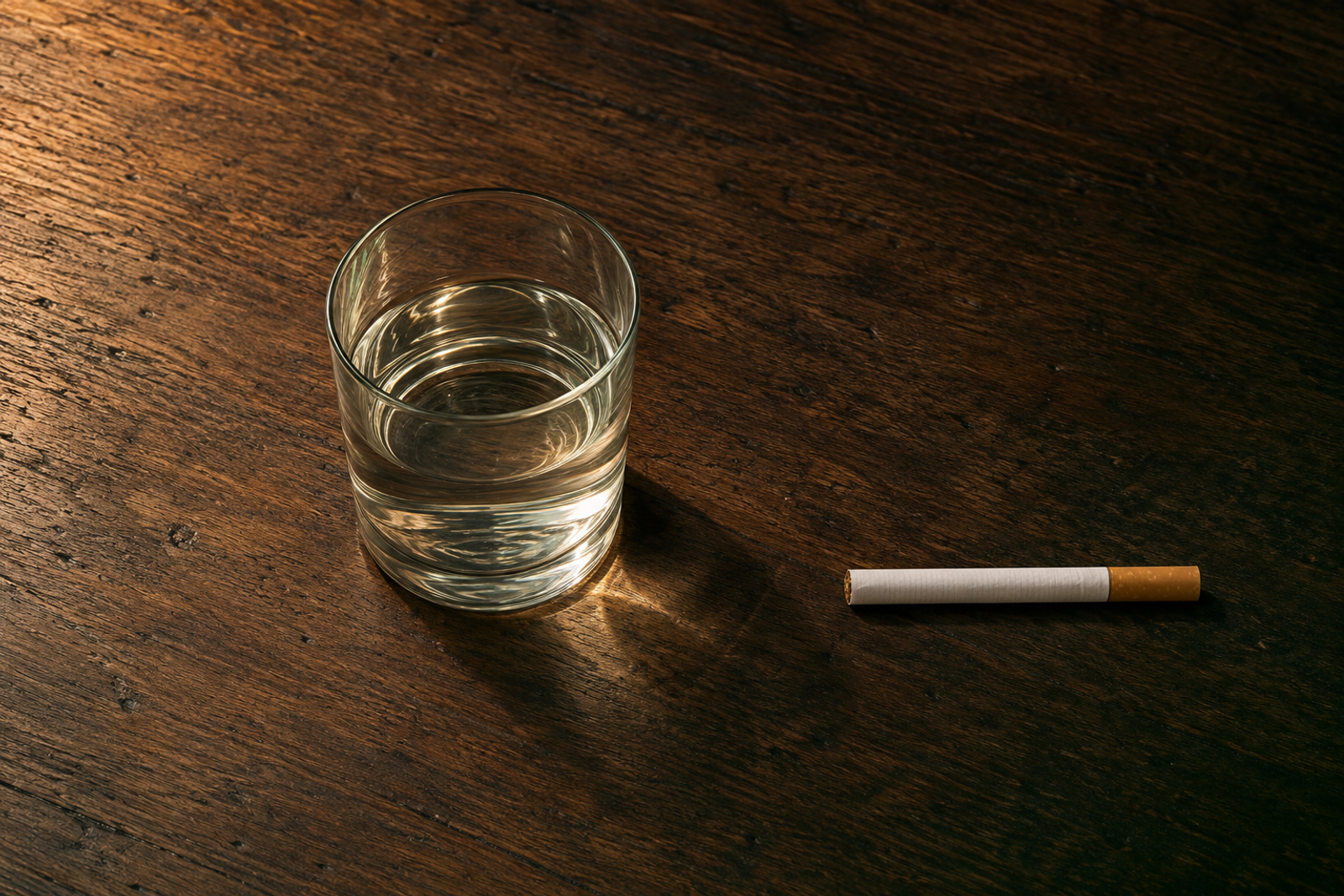
Because the drink and the cigarette were learned together. For a lot of people the two arrived in the same rooms, with the same people, at the same hour of the same nights — so the first sip now works as a cue in its own right. The pull isn't information about what your body needs. It's a pattern doing what patterns do.
Which is why people who've gone weeks without thinking about it lose it on a Friday.
"I only smoke when I drink" is the clue, not the exception
It's the most common thing anyone says about this, usually as reassurance. Look at it again and it's actually the strongest evidence that the habit is situational.
If the reaching were driven by a shortfall, it would show up on Tuesday afternoon too. It doesn't. It shows up at the table. That's a cue, and it behaves like the one that fires when you push your plate away — the same loop, just rehearsed in a different room.
The drinking version is usually harder for three reasons that have nothing to do with chemistry.
Three things stack, and none of them are about the alcohol
The rules get renegotiated. Whatever you decided on Wednesday — not this month, not anymore — is a decision you made in one state of mind and are now reviewing in another. Nothing has to break for this to happen. The rule just gets a fresh hearing from someone with a different mood and a weaker interest in enforcing it. And the case for one cigarette is very good at 11pm.
Everyone steps out together. The cigarette isn't a solo act here. It's the reason a group leaves the table, stands in a circle, and keeps talking without the music. Declining it isn't declining a cigarette; it's staying behind. That's a social cost, and it's real — it's why these are beliefs you were handed rather than ones you built, and why handed-down habits hold on longer.
The night has a shape you've done before. Same lane, same order, same three people, same point in the evening where someone taps the pack. You are not resisting one urge. You're moving through a sequence that has a cigarette written into it at a predictable place.
Why "I'll just not think about it" is the worst plan available
The standard approach is to go out and hold the line by force — keep it off your mind, don't look at the pack, white-knuckle it.
There's a reasonably well-known experiment on exactly this. Smokers who were told to actively suppress thoughts of smoking went on to smoke more over the following days than those who weren't — Erskine, Georgiou and Kvavilashvili, Psychological Science, 2010. Pushing the thought down is itself an act of rehearsal, and it costs attention you don't have much of at the end of a long night.
So the plan that most people bring to a night out is the one with a demonstrated failure mode built into it.
Also not the answer: don't go
Skipping the evening works. It works the way skipping meals would work for the after-lunch cigarette — by removing the situation instead of changing what happens in it.
The trade is bad. You've shrunk your life to manage a habit, which is roughly the opposite of the point, and the association is untouched underneath. It's still there in four months when you do go, and it will be exactly as strong, because nothing has happened to weaken it.
Cues fade when they fire and nothing follows. Avoidance never gives them that chance.
What to actually do, decided before you leave the house
The one move with real evidence behind it is boring: write the specific plan in advance, in if-then form. Not an intention to be careful — a sentence naming the situation and the response.
If Arjun taps the pack and stands up, then I go out with them and hold my glass.
This is the difference between a goal and a plan, and it's been measured a lot. A 2025 meta-analysis pooling 642 tests found that if-then plans reliably close the gap between what people intend and what they do — Sheeran, Listrom and Gollwitzer, European Review of Social Psychology. The mechanism is unglamorous: you've already made the decision, so the moment doesn't require one.
Things worth building into yours:
Go out with them anyway. The cue fires, you're standing in it, and nothing follows. That's the repetition that actually does the work. Staying at the table teaches you less.
Give your hands the job. Hold the glass, hold your phone, hold the railing. Most of the reach is a reach.
Name the pull when it comes. That's the circle. Once it's something you're watching rather than something happening to you, the difference between the urge and the story about the urge opens up — and the story is the part that says one is fine.
Tell one person before the first drink. Not a speech. "I'm not smoking tonight" said out loud to one friend at 9pm is much harder to quietly reverse at midnight than a private resolution is.
Decide what you do if you smoke one. Most plans have no clause for this, so a single cigarette becomes the end of the attempt rather than an event with a next step. Write the clause.
And if the circle rather than the drink is the real problem — the office break, the flatmate, the group that steps out together — that is its own piece.
Expect the social ones to be the last to go. Private cues fade quietly; the ones with other people attached take longer, because you're unlearning them in a room that's still running the old pattern.
Where Nicoxit comes in
Triggers are the spine of the first half of the course, and the social ones get their own treatment — because "step out with the group" is a different problem from "the 11am one."
You keep smoking through the first six days, which is what makes the logging work: you can only catalogue a pattern you're still performing. If your smoking is mostly social, a weekend inside those six days tells you more than a fortnight of weekdays would.
The Anchor statement is where the if-then plan lives — one written sentence, made in advance, aimed at your own most common trigger rather than a generic list. It's 31 modules over seven days, about forty minutes a day, and then it's done. A course first, with the tracker that follows it. Cigarettes, vapes, hookah and IQOS.
The drink didn't decide. The table did, months ago.
References
- Erskine, J. A. K., Georgiou, G. J., & Kvavilashvili, L. (2010). I suppress, therefore I smoke: Effects of thought suppression on smoking behavior. Psychological Science, 21(9), 1225–1230. https://doi.org/10.1177/0956797610378687
- Sheeran, P., Listrom, O., & Gollwitzer, P. M. (2025). The when and how of planning: Meta-analysis of the scope and components of implementation intentions in 642 tests. European Review of Social Psychology, 36(1), 162–194. https://doi.org/10.1080/10463283.2024.2334563
Frequently asked questions
Why do I want a cigarette when I drink?
Because the two were learned together — same rooms, same people, same hour — so the drink now works as a cue on its own. It's a rehearsed pattern rather than something your body is asking for, which is why it shows up on a Friday and not on a Tuesday afternoon.
Is it possible to drink without smoking?
Yes, and it's the repetition that matters most, because it's the one that weakens the cue. It needs a plan made before you go out rather than a decision made at the table, and it usually takes several nights before the evening stops feeling like it's missing a step.
Should I stop drinking while I quit smoking?
Avoiding the situation works while you avoid it and leaves the association intact underneath. Changing what happens at the table does more long-term than staying away from the table, though some people choose to step back for the first few weeks and that's a reasonable call.
Why do I only smoke when I drink — am I still addicted?
The label matters less than the pattern. Purely social smoking is a cue-driven habit with real staying power, and people who describe themselves this way are often the ones who find it hardest to stop, because the trigger arrives with friends attached.
What do I do when everyone steps out for a cigarette?
Go with them. The point is to be standing in the cue with nothing following it, which is what makes it fade. Hold a drink, keep talking, and decide the sentence before you leave home rather than in the doorway.