
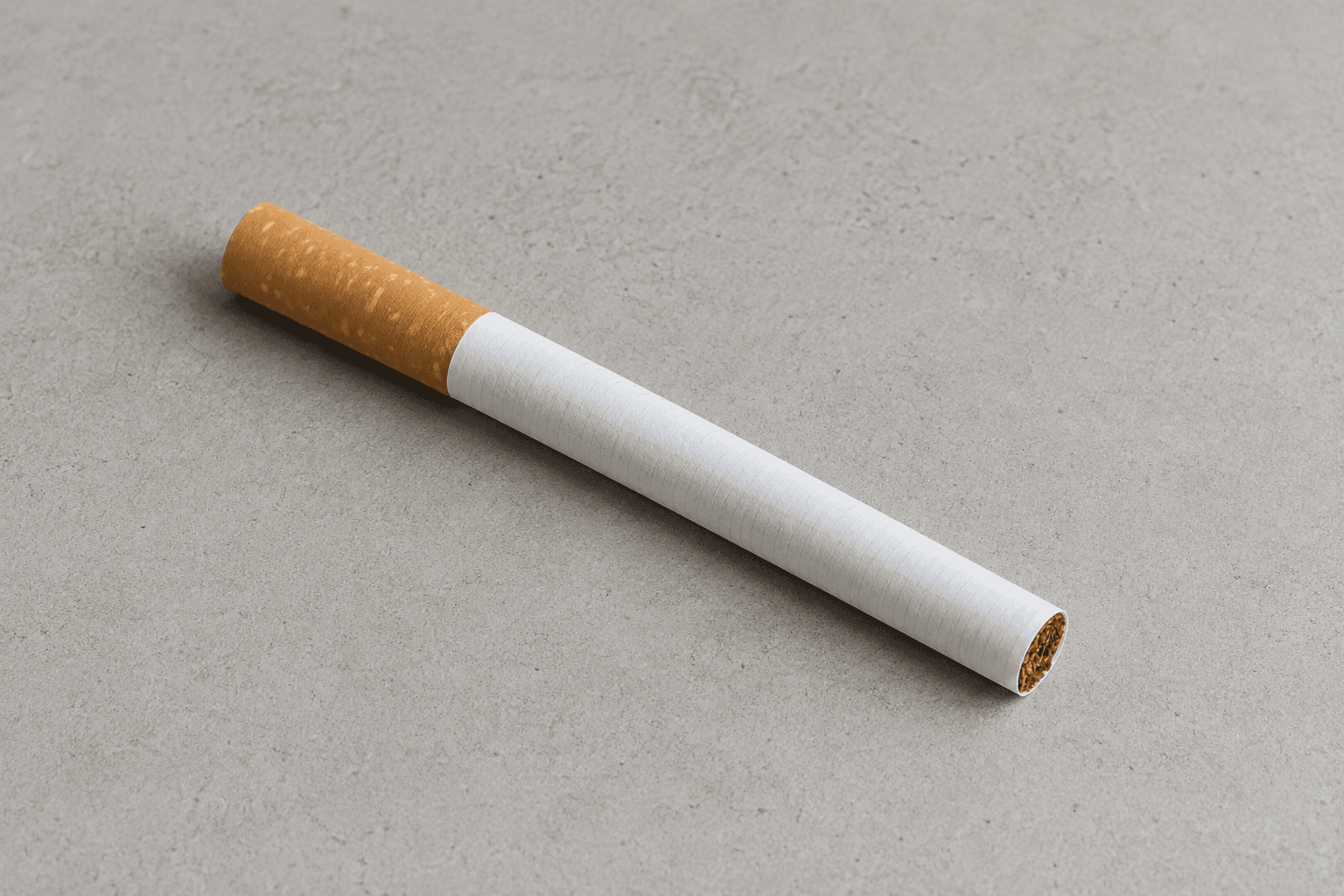
One cigarette a day is associated with roughly half the excess heart disease risk of twenty a day, not a twentieth of it. That is the single most surprising number in the smoking literature, and almost nobody who has cut down has heard it.
If risk rose in a straight line with consumption, someone smoking one a day would carry about 5% of the extra risk of someone smoking twenty. That is the intuition behind cutting down, and it is roughly what happens with lung cancer. For heart disease and stroke, it is not what the data shows.
What the meta-analysis found
The source is a 2018 meta-analysis in the BMJ that pooled 141 cohort studies drawn from 55 publications, specifically to quantify risk at low consumption.
For coronary heart disease, men smoking about one cigarette a day had a pooled relative risk of 1.48 against never-smokers, compared with 2.04 at twenty a day. Among women the figures were 1.57 and 2.84. In the subset of studies that adjusted for multiple confounders, the numbers were higher still: 1.74 and 2.27 for men, 2.19 and 3.95 for women.
Expressed as a share of the excess risk carried by a twenty-a-day smoker, one a day came to 46% for men and 31% for women, rising to 53% and 38% in the multiply-adjusted studies.
For stroke, the pooled relative risks at one a day were 1.25 for men and 1.31 for women, against 1.64 and 2.16 at twenty a day. As a share of the excess risk at twenty a day, one cigarette accounted for 41% in men and 34% in women.
The authors' conclusion was that no safe level of smoking exists for cardiovascular disease, and that smokers should aim to quit rather than cut down.
How to read those numbers
Three things need saying, because this is exactly the kind of figure that gets quoted without them.
Start with the one that gets misread most. "46% of the excess risk of twenty a day" does not mean a 46% chance of anything, and it does not mean 46% of a twenty-a-day smoker's total risk. Excess risk is the gap between a never-smoker and a smoker. At the population level, the figure means that one cigarette a day was associated with 46% of the excess coronary heart disease risk seen at twenty a day in men, and 31% in women, where the arithmetic of cutting down implies a twentieth. It is not an individual prediction. The surprise is in the shape of the curve, not in the size of any one person's danger.
These are relative risks, not absolute ones. A relative risk of 1.48 means roughly 48% higher risk than a never-smoker's, and your never-smoker baseline depends heavily on your age, blood pressure, cholesterol and whether you have diabetes. A large proportional increase on a small base is still a small absolute number for most people in their twenties. The reason the figure matters is not that it makes one cigarette dangerous today. It is that cutting down to one does not return you anywhere near baseline.
These are observational cohort studies. They establish association, adjusted for confounders to varying degrees, and they do not demonstrate cause on their own.
The adjustment is worth a second look, because it did not move every estimate the same way. For coronary heart disease, the multiply adjusted figures came out higher than the pooled ones in both men and women. For stroke the pattern was mixed rather than uniform, and those estimates are better read separately. Adjustment can move an estimate in either direction, so no single explanation covers all of these results.
The analysis is eight years old and its literature search ran to May 2015. We are disclosing that rather than hiding it. We searched for something that supersedes it and found nothing comparable: it remains the largest pooled estimate aimed specifically at low consumption. A 2021 review in Archives of Medical Science: Atherosclerotic Diseases covers the same ground and reaches the same position, that there is no safe level, though it is a narrative review rather than a pooled analysis and carries less weight accordingly.
Why "how many a day is safe" has no number
People search for a threshold. The literature does not supply one. For coronary heart disease and stroke, the analysis found that the rise in relative risk is not proportional to the number of cigarettes smoked: low daily consumption was associated with a substantial share of the excess risk seen at much higher consumption. That shape should not be generalised to every smoking-related outcome. Lung cancer, as the same analysis notes, behaves closer to the straight line people expect.
That is also why the question "is one a week bad" does not get a cleaner answer. The analysis modelled one, five and twenty a day. Below one a day it is extrapolation, and we are not going to invent a figure for it.
Our view, not the study's
Here is our argument, and it is ours rather than anything the meta-analysis measured.
Cutting down to one or two feels like the most responsible thing a smoker can do. It is visible, it is measurable, and it produces real approval from everyone around you. What it also produces is a daily decision that has to be won again every day, and a cigarette that now carries enormous weight because it is the only one.
The number above is doing something uncomfortable to that arrangement. It says the health case for stopping at one is far weaker than it feels, which makes it one of the beliefs most smokers are carrying without having chosen them. We think the behavioural case is weaker too, and we have written about what the evidence does and does not say about cutting down versus stopping. Note that the meta-analysis authors' recommendation to quit rather than cut down is a statement about risk, not the result of a trial comparing the two methods.
If you are already down to one a day, you are not failing. You are holding a position that is harder to hold than it looks, for less benefit than you were promised.
It is also why the seven days do not open by asking you to smoke less. Cutting down puts the whole weight of the attempt on a decision you have to keep winning, usually at the exact moments you are least equipped to win it. The work happens instead on what those moments are, what you have learned to expect from them, and what you do when one arrives. The count comes down as a consequence rather than as the instruction.
Where Nicoxit comes in
Nicoxit is a seven-day journey, 31 modules, built on published behavioural science, covering cigarettes, vapes, hookah and IQOS. It does not ask you to cut down first. You keep smoking while you work through it, which is deliberate, and it explains why.
If you are worried about your heart, that is a conversation to have with a doctor who can actually examine you, not a question an article can settle.
Not medical advice.
References
- Hackshaw, A., Morris, J. K., Boniface, S., Tang, J. L., & Milenković, D. (2018). Low cigarette consumption and risk of coronary heart disease and stroke: Meta-analysis of 141 cohort studies in 55 study reports. BMJ, 360, j5855. https://doi.org/10.1136/bmj.j5855
- Katsi, V., Maragkoudakis, S., Ioakeimidis, N., Marketou, M., Parthenakis, F., Vlachopoulos, C., & Tsioufis, K. (2021). The cardiovascular burden of light smoking. Archives of Medical Science: Atherosclerotic Diseases, 6, e48–e56. https://doi.org/10.5114/amsad.2021.105313
Frequently asked questions
Is one cigarette a day actually bad for you?
On the largest pooled analysis of low consumption, about one a day was associated with roughly 46% of the excess coronary heart disease risk carried by a twenty-a-day smoker in men, and 31% in women. If risk rose in a straight line you would expect about 5%.
How many cigarettes a day is safe?
The evidence does not give a safe number for cardiovascular disease, and the authors of the main analysis concluded that no safe level exists. Most of the proportional risk appears early in the curve rather than accumulating evenly.
Is one cigarette a week bad?
The analysis modelled one, five and twenty a day. Anything below one a day is extrapolation from its figures, and we are not going to supply a number it did not produce.
Does cutting down reduce my risk at all?
Going from twenty to one is associated with lower risk than staying at twenty. It is not associated with anything close to a never-smoker's risk, which is the part the "cutting down" framing tends to leave out.
Is this the same as smoking one cigarette after quitting?
No. That is a different situation with a different question behind it, and we have written about what happens after a single cigarette during a quit attempt separately.