
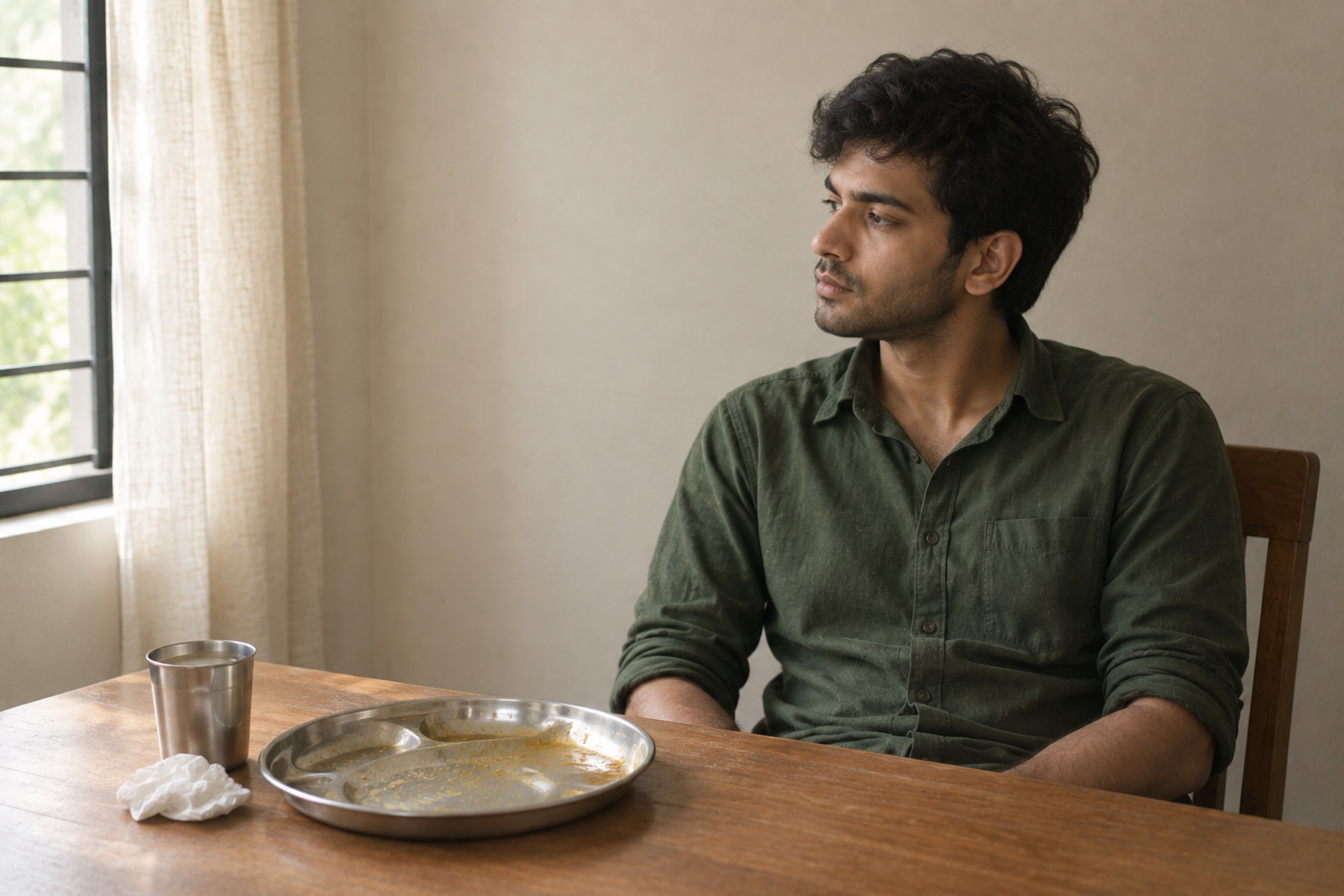
Because you taught yourself to. Not metaphorically — the pairing is a piece of learning your brain did on its own, reinforced a few thousand times, and it runs whether or not there's any nicotine shortage to explain it.
Which is why the pull after a meal often feels stronger than the one at 11am, even though 11am is further from your last cigarette.
The cue is doing the work, not the chemistry
If the urge were purely about nicotine dropping off, it would track the clock. It doesn't. It tracks situations.
Pushing the plate away. The last sip of chai. The auto stopping at your lane. The second drink. Stepping out of the office with the same two people. These are cues, and the brain has attached each of them to the reward that reliably followed. After enough repetitions the cue alone produces the wanting — before you've decided anything, and often before you've noticed the cue at all.
It's the same dopamine loop that makes the first cigarette of the day feel non-negotiable. The meal version is just better rehearsed, because meals happen on a schedule and your brain likes a schedule.
Why food in particular
Three things stack, and none of them require you to have a deficiency.
The meal ends. Habits attach easily to transitions — the end of a task, the end of a call, the end of a plate — because a transition is an unmistakable signal, and unmistakable signals make good cues.
There's usually a pause built in. You're sitting, the work is done for a moment, nobody needs anything. That pocket of nothing is exactly where the habit fits.
And in India the pairing has a shape around it. Chai and a cigarette isn't a private routine you invented; it's a break other people take with you, at a shop you go to, with a script for how it starts. That makes it one of the beliefs you were handed rather than one you formed, and handed-down habits are sturdier, because breaking them costs something socially as well as personally.
The relief is real. The benefit isn't.
People describe the after-meal cigarette as the best one of the day, and that report is honest. It does feel better.
What's happening is mostly the closing of a gap. Nicotine levels have been falling since the last one, producing a low-grade restlessness you've stopped attributing to nicotine because it's simply what afternoons feel like. The cigarette removes it. Relief that arrives on cue is very easy to mistake for pleasure.
The wider evidence points the same way: smokers report higher stress than non-smokers, and stress tends to fall after quitting rather than rise — Parrott, American Psychologist, 1999. We've written about why the relaxation story doesn't survive contact with the research.
None of which makes the urge less real at 2:15pm. It just means the thing it's promising isn't what's being delivered.
What doesn't work: avoiding the cue forever
The obvious move is to skip the after-lunch break. Stop having the chai. Take a different route.
It works, briefly, and it's a bad long-term trade for two reasons. You've made your life smaller to accommodate a habit, which is the opposite of what quitting is supposed to buy you. And the association is still intact — it's just waiting. Six months on, at a wedding, someone hands you chai and the whole thing is exactly where you left it.
Cues weaken when they're met and not followed by the reward. Not when they're dodged.
What does work: keep the meal, break the sequence
The cue has to fire and then go unrewarded. That's the entire mechanism, and everything below is a way of arranging it.
Notice the cue as a cue. When the pull arrives, name what triggered it — that's the plate. Naming it moves it from something happening to you to something you're observing. This is the urge-versus-craving distinction at work: the urge is the pull, the story about needing it is separate, and you can decline the story while the pull is still there.
Stay in the situation and let it pass. Finish the meal. Stay at the table. The pull rises and falls, usually in a few minutes, and sitting through one intact teaches your brain something that leaving the table doesn't.
Put something else in the gap. Not as a substitute reward — as an occupant of the pause. Walk to the end of the street. Wash your cup. The point is that the slot gets filled.
Write the plan before the meal. If I finish lunch and want one, then I walk to the gate and back. Decided in advance, not negotiated at 2:15.
Expect it to take more than one lunch. You built the association over years of repetitions. You're unbuilding it over dozens.
Where Nicoxit comes in
Triggers are the spine of the first half of our seven-day course. Day 3 has you log what actually sets the reaching off — and the log stays open, so by Day 6 you're writing your if-then plans against your own most common cue rather than a generic list.
The course runs 31 modules over seven days, about forty minutes a day, and then it's done. You keep smoking through the first six days, which is what makes the logging useful — you can only catalogue a habit you're still performing. It covers cigarettes, vapes, hookah and IQOS. Day 1's first three modules are free, modules 1 to 3 of six.
After the course, the awareness log and Your Wins keep going, and Your Wins will tell you your most common trigger without you having to guess.
The chai was never the problem. It just kept the appointment.
Not medical advice.
References
- Parrott, A. C. (1999). Does cigarette smoking cause stress? American Psychologist, 54(10), 817–820. https://doi.org/10.1037/0003-066X.54.10.817
Frequently asked questions
Why do I want a cigarette after eating?
It's a learned cue rather than a nicotine requirement. The end of a meal is a clear transition with a pause built into it, and if a cigarette has reliably followed that pause, the pause alone starts producing the wanting.
Is the after-meal cigarette really the best one?
It feels that way because it closes a gap that's been widening since the last one. What you're registering is relief from withdrawal rather than a benefit the cigarette adds.
Should I skip the meal break or the chai while I quit?
Avoiding the cue works for a few weeks and leaves the association intact. Cues weaken when they fire without the reward following, so keeping the break and changing what comes after it does more.
How long until the after-meal craving stops?
It fades with repetitions rather than on a fixed timetable — each time the cue fires and nothing follows, it weakens a little. Expect weeks, not days, and expect the social ones to outlast the private ones.
What should I do instead in that moment?
Something that occupies the pause rather than replaces the reward — a short walk, clearing the table, stepping outside without the cigarette. Decide it before the meal, not during the craving.