
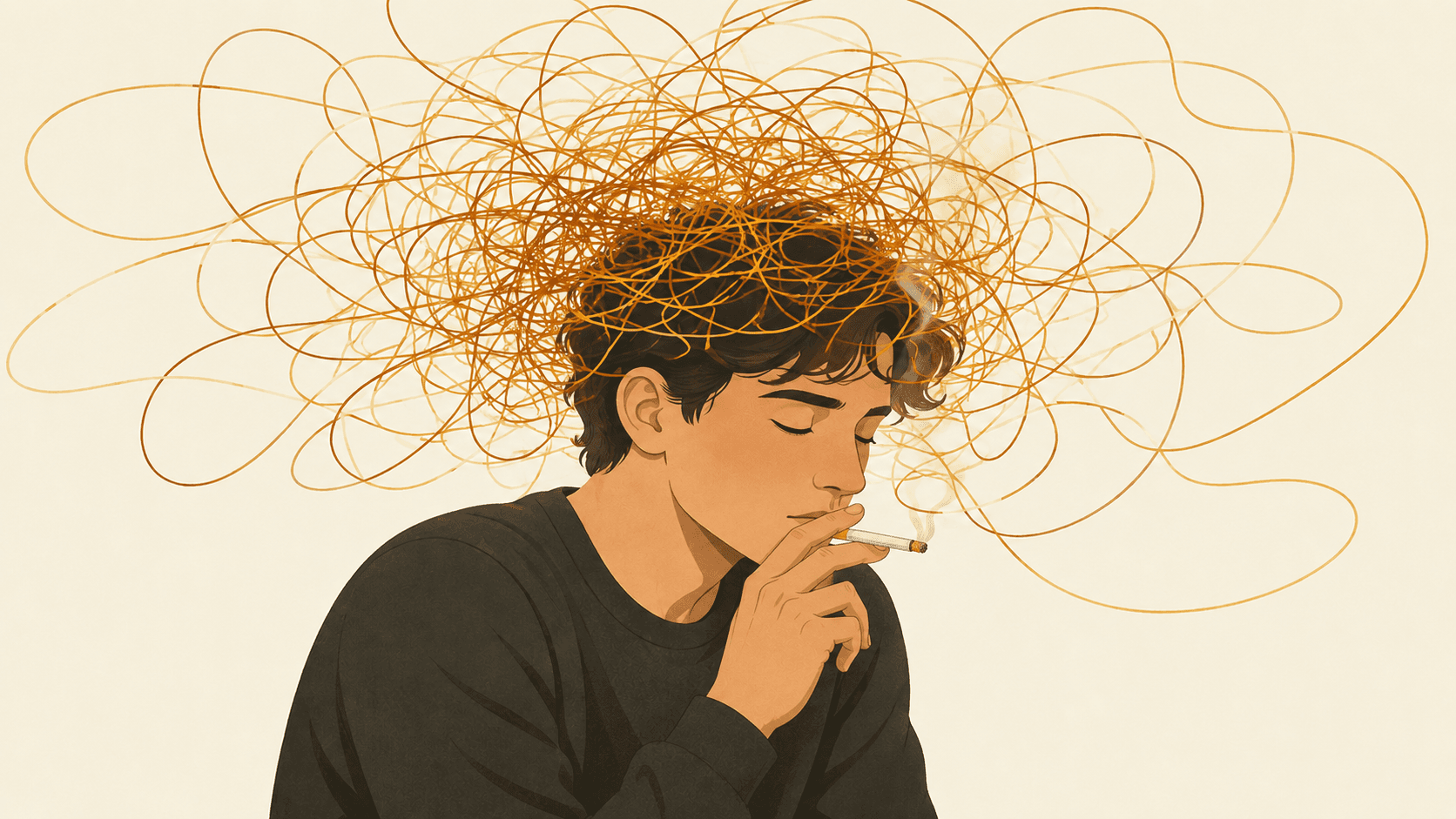
When you're anxious, the cigarette feels like the one thing that helps. The chest loosens, the thoughts slow, the world gets a half-step further away. That relief is real — you're not imagining it. So it feels obvious that smoking calms anxiety.
The research points, clearly and consistently, the other way. And understanding why is the difference between managing your anxiety and feeding it.
The short answer: no — and quitting is linked to less anxiety
If cigarettes genuinely treated anxiety, smokers would be calmer than non-smokers, and quitting would make anxiety worse. Neither is true.
A 2021 Cochrane review — 102 studies, more than 169,000 people — found that stopping smoking for at least six weeks was associated with lower anxiety, depression and stress, and with better mood and psychological wellbeing, compared with continuing to smoke. The reviewers put the size of that improvement at least on a par with what antidepressant treatment achieves. That's a comparison of scale. It doesn't make quitting a substitute for treatment. The pattern held for people already living with a mental health condition.
One caveat the reviewers state plainly: this is observational evidence, and they rate their confidence in it from very low to moderate. The direction is consistent across studies. The size is less certain.
Quitting, on average, doesn't cost you your calm. It's associated with getting more of it back.
Why it feels like it helps
So why does the cigarette feel like relief in the moment? The best-supported explanation, and the one we covered in why smoking isn't actually relaxing, is that much of the anxiety being relieved is anxiety the last cigarette helped create.
Nicotine actually clears the body slowly — its half-life in the blood is around two to three hours, so levels build through the day and fall away overnight. What moves fast is the effect. The lift from a cigarette fades within minutes, and for a regular smoker the low, restless, edgy feeling of early withdrawal can start building well before the nicotine has gone. That feeling is easy to mistake for anxiety. The next cigarette clears it, and your brain files that away as "smoking calms me down." It did — but only back to the baseline a non-smoker never left.
So a smoker spends the day on a low anxiety saw-tooth: a dip of withdrawal-anxiety, a top-up, a dip, a top-up. Each cigarette feels like it's treating your anxiety. What it's actually doing is scheduling the next wave of it.
What quitting actually does
This is the hopeful part, and it's worth sitting with if you've been told — or told yourself — that you can't quit because you "need" it for your nerves.
The Cochrane review found the anxiety, low mood, and stress didn't rise after quitting once the initial withdrawal passed. They fell. People weren't white-knuckling through a permanently more anxious life. They were coming out the other side of the withdrawal loop into a steadier baseline than the one nicotine had been resetting them to all day.
That doesn't mean the first days are easy — the withdrawal edge is real, and it's sharpest in the first week. But it's a passing phase on the way down, not the new normal.
And if the attempt doesn't hold? A 2025 review in BMJ Open — 62 studies, just over 36,000 people — looked at exactly that. People who quit successfully saw the biggest improvement in anxiety and low mood. But people whose attempt didn't hold were, on the whole, no worse off than before they started. Across 46 studies measuring depression, 45 found no change or an improvement, even among those who went back to smoking.
So if the fear of trying and failing is what's holding you in place, that fear is costing you more than the failure would. An attempt that doesn't hold still tells you which belief pulled you back.
An honest note if you live with anxiety
This is a blog, not a doctor, and anxiety is not one-size-fits-all. Quitting abruptly isn't dangerous in itself — for most people it's simply a method, and it's the one this course is built on. One situation does need care, though.
It's tobacco smoke, not nicotine, that speeds up a liver enzyme which clears several common medications — including some antipsychotics and antidepressants, and ordinary caffeine. When you stop smoking, that effect reverses within days and the level of those medicines in your blood can rise. So tell your prescriber you're quitting, and let them check whether a dose needs reviewing. Never adjust one yourself on the strength of an article. None of this is a reason to keep smoking — nicotine replacement and vaping don't produce the effect either, because it comes from the smoke.
What the evidence pushes back on is the specific belief that smoking is treating your anxiety. For most people, it isn't. It's managing a withdrawal it created — and that belief is worth examining honestly, which is exactly what a belief-first method is for.
How to quit when anxiety is the trigger
If anxiety is the thing that sends you to the cigarette, the method is the same one that works for any belief-driven craving:
- Name the belief before you reach. "I believe this will calm me." Saying it makes it testable.
- Check it afterwards. Is the anxious thought resolved, or did you just quiet the craving? Ten honest checks and the belief starts to come apart.
- Ride the wave. An anxiety-driven craving, like any craving, rises and passes in minutes if you don't feed it. You're waiting it out, not fighting it forever.
The position this post defends
The belief that smoking treats anxiety is one of the stickiest there is, because the relief is genuine and immediate. But genuine relief from a discomfort the drug created is not the same as treating the thing you're actually anxious about. The research is consistent: on average, quitting is associated with less anxiety, not more.
The cigarette isn't treating your anxiety. It's scheduling the next wave of it.
Curious which belief is really driving your habit? Take the 3-minute Quit Profile quiz, and your personalised plan lands in your inbox the morning we launch.
References
- Taylor, G. M. J., Lindson, N., Farley, A., Leinberger-Jabari, A., Sawyer, K., Te Water Naudé, R., Theodoulou, A., King, N., Burke, C., & Aveyard, P. (2021). Smoking cessation for improving mental health. Cochrane Database of Systematic Reviews, 3, CD013522. https://doi.org/10.1002/14651858.CD013522.pub2
- Crabb, A. B., Allen, J., & Taylor, G. (2025). What if I fail? Unsuccessful smoking cessation attempts and symptoms of depression and anxiety: a systematic review and meta-analysis. BMJ Open, 15(5), e091419. https://doi.org/10.1136/bmjopen-2024-091419
- Kim, B., Bae, S. H., Bashar, M., et al. (2025). Development of a physiologically based pharmacokinetic (PBPK) simulation model for nicotine. Biopharmaceutics & Drug Disposition, 46(5–6), 209–220. https://doi.org/10.1002/bdd.70018
- NHS Specialist Pharmacy Service (2023). Considering drug interactions with smoking. https://sps.nhs.uk/articles/considering-drug-interactions-with-smoking/
- National Cancer Institute. Handling Nicotine Withdrawal and Triggers When You Decide to Quit Tobacco. https://www.cancer.gov/about-cancer/causes-prevention/risk/tobacco/withdrawal-fact-sheet
Frequently asked questions
Does smoking help anxiety?
No. The relief appears to be mostly your own nicotine withdrawal easing — the cigarette relieves a discomfort it created. A 2021 Cochrane review of 102 studies found people who quit had lower anxiety, depression and stress than those who kept smoking.
Will quitting smoking make my anxiety worse?
There's a withdrawal phase in the first days that can feel like anxiety. But the 2021 Cochrane review found that by follow-up, people who quit scored better on anxiety, depression and stress than those who kept smoking - an improvement the reviewers put on a par in size with antidepressant treatment. This is observational evidence, so it shows a consistent pattern rather than proof of cause.
Why do I feel anxious when I haven't had a cigarette?
That's most often nicotine withdrawal, which produces irritability, restlessness and poor concentration — symptoms that closely mimic anxiety. The US National Cancer Institute notes these peak around day three and ease over the first month. The next cigarette relieves them, which is why smoking feels like treatment.
I have an anxiety disorder — should I still quit?
The 2021 Cochrane review found no evidence the mental-health benefit was smaller for people with psychiatric conditions. If you take medication, tell your prescriber before you quit: it's tobacco smoke rather than nicotine that speeds up how your body clears several psychiatric medicines, so levels can rise once you stop and a dose may need reviewing. Have that conversation early, and don't let it delay the quit.
Does vaping help anxiety?
No, the same loop applies. Vaping delivers nicotine, so it creates the same withdrawal cycle that feels like relief. Because vapes allow low-level dosing all day, the cycle can run more continuously than with cigarettes.
What if I try to quit and it doesn't work?
You're very likely no worse off for having tried. A 2025 BMJ Open review of 62 studies found that people whose quit attempt didn't hold showed no worsening in anxiety or depression compared with before they tried, while those who did quit improved the most. A failed attempt still tells you which belief pulled you back.